Natick Center Historic District

Why it's listed
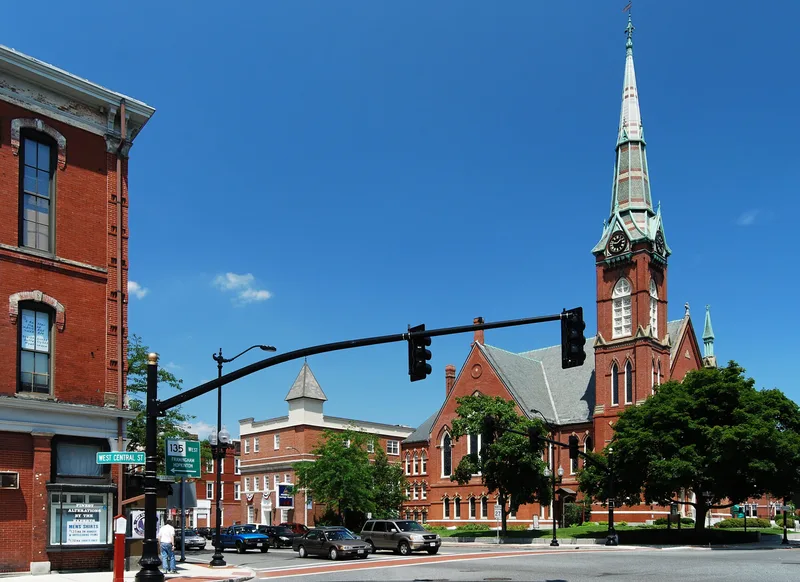
Natick Center is the commercial and civic heart of the town, a compact group of fifteen buildings along Main Street near its crossing with Central Street. A fire on January 13, 1874 leveled nearly all of the principal downtown buildings, and twelve structures in the district were rebuilt between 1874 and 1888. The result is a continuous wall of 19th-century storefronts with a consistent scale, color and texture. High Victorian Gothic dominates, seen in the First Congregational Church, the Morse Institute library and the Masonic Block. Clark's Block is Italianate, and the Walcott Building shows Richardsonian Romanesque influence. The district also holds the Harwood Baseball Shop, built in 1858 and reported to be the oldest factory of its kind in the country, a 1875 central fire station, and a turn-of-the-century diner. The area was important to Natick's shoemaking-era prosperity and municipal life, and it survived largely intact because little later growth replaced it.
Machine-generated summary. This summary was generated by a language model from the official nomination document and has not been reviewed line by line by an editor. It may contain errors. Check the source document before relying on any detail. Source: nomination document (PDF) · catalog entry. Generated October 2026 (model claude-sonnet-5-5, prompt v1.0-2026-10-29).
| Period of significance | 1800-1899 |
|---|---|
| Styles | High Victorian Gothic, with Italianate, Richardsonian Romanesque and simple commercial styles |
| Areas of significance | Industry, Commerce, Architecture |
| Acreage | 4.8 |
| Boundary source | NPS cultural-resource GIS polygon |
| Full listing page | Natick Center Historic District (property record) |
What listing means for this property
This is a historic district. Buildings within its boundary are either contributing (they add to the district's significance) or non-contributing. Owners of contributing income-producing buildings can claim the 20% federal rehabilitation tax credit; homeowners should look at state credits. National Register districts impose no design review by themselves; a local historic district ordinance, if one exists, does (the difference explained).
General information, not legal or tax advice. Rules change; confirm with your State Historic Preservation Office or a qualified adviser.