Morton Road Historic District

Why it's listed
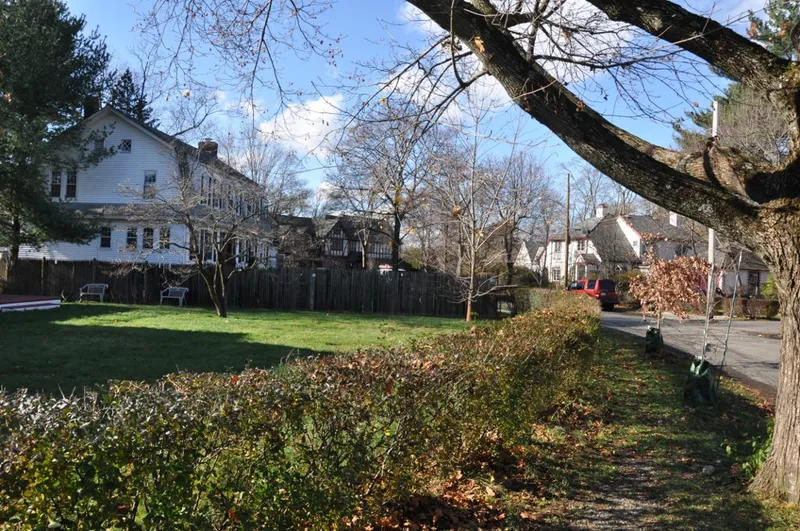
Morton Road is a short, L-shaped residential street in Newton Centre, just north of Commonwealth Avenue. Laid out in 1915 by developer Newton Associates, it was planned by architect Gilbert Miles Ramsey, whose subdivision plan showed building footprints and plantings. The district takes in six houses on the road and two on Morton Street, with six contributing houses and three matching garages in Craftsman and Tudor Revival styles. Craftsman cottages have stucco walls, brick trim, clipped gable roofs and multi-pane windows, while two Tudor Revival cottages near the turn-around show half-timbering. A slight bend, a curved corner, a widened turn-around and mature shade trees add to the small-scale character. Two non-contributing houses, a four-square and a Colonial Revival, differ mainly in scale and detail. The district matters as an example of how construction near Commonwealth Avenue accelerated after 1914, peaking in the 1920s, and for the quality of its planned layout and architecture.
Machine-generated summary. This summary was generated by a language model from the official nomination document and has not been reviewed line by line by an editor. It may contain errors. Check the source document before relying on any detail. Source: nomination document (PDF) · catalog entry. Generated October 2026 (model claude-sonnet-5-5, prompt v1.0-2026-10-29).
| Period of significance | 1910s-1920s |
|---|---|
| Styles | Craftsman and Tudor Revival |
| Areas of significance | Community Planning and Development, Architecture |
| Acreage | 1.8 |
| Boundary source | NPS cultural-resource GIS polygon |
| Full listing page | Morton Road Historic District (property record) |
What listing means for this property
This is a historic district. Buildings within its boundary are either contributing (they add to the district's significance) or non-contributing. Owners of contributing income-producing buildings can claim the 20% federal rehabilitation tax credit; homeowners should look at state credits. National Register districts impose no design review by themselves; a local historic district ordinance, if one exists, does (the difference explained).
General information, not legal or tax advice. Rules change; confirm with your State Historic Preservation Office or a qualified adviser.