Monument Square Historic District

Why it's listed
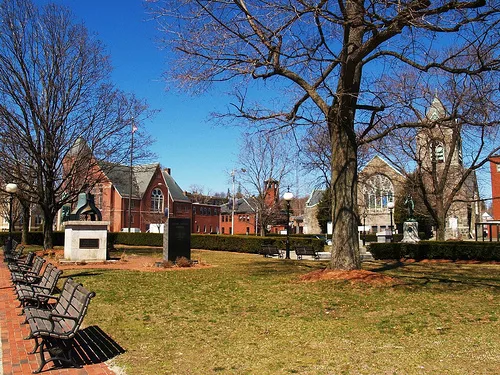
Monument Square Historic District covers roughly 30 acres in the middle of downtown Leominster, Massachusetts. It contains 36 properties arranged around a small triangular common, with civic and religious buildings near the common and commercial blocks along Main Street. Nearly all are red brick with granite trim, two to four stories tall. The buildings range from the Greek Revival Balch Place, the oldest in the district, to Victorian Gothic and Italianate churches and shops, the 1878 Gothic Revival railroad depot, and Neoclassical and Renaissance Revival structures such as the public library, municipal building, Richardson Building, and Mary A. Gallagher Junior High School. The Rialto Theater dates from 1923. The district matters as the commercial and civic center of a city whose comb, piano case, and plastics industries peaked around 1900 to 1920. Storefront alterations and some later infill are noted, but the scale, masonry and design remain largely intact.
Machine-generated summary. This summary was generated by a language model from the official nomination document and has not been reviewed line by line by an editor. It may contain errors. Check the source document before relying on any detail. Source: nomination document (PDF) · catalog entry. Generated October 2026 (model claude-sonnet-5-5, prompt v1.0-2026-10-29).
| Period of significance | 1800-1899 and 1900- (specific dates multiple) |
|---|---|
| Styles | Victorian and revival styles (Greek Revival, Italianate, Gothic Revival, Romanesque, Renaissance Revival, Neoclassical) |
| Areas of significance | Commerce, Politics/Government, Architecture |
| Acreage | 30 |
| Boundary source | NPS cultural-resource GIS polygon |
| Full listing page | Monument Square Historic District (property record) |
What listing means for this property
This is a historic district. Buildings within its boundary are either contributing (they add to the district's significance) or non-contributing. Owners of contributing income-producing buildings can claim the 20% federal rehabilitation tax credit; homeowners should look at state credits. National Register districts impose no design review by themselves; a local historic district ordinance, if one exists, does (the difference explained).
General information, not legal or tax advice. Rules change; confirm with your State Historic Preservation Office or a qualified adviser.