Monument Square-Eagle Street Historic District

The National Park Service has not published a boundary polygon for this district; the map shows the listed properties inside it and the district's reference point.
Why it's listed
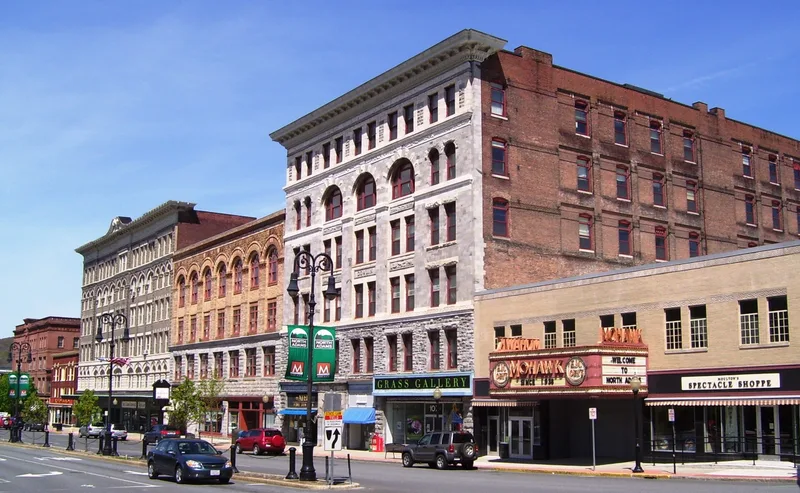
Monument Square and Eagle Street form the historic core of North Adams, Massachusetts. The square, named for a soldiers' monument raised in the 1870s after the Civil War, is ringed by churches: the First Baptist Church (rebuilt 1879 after a fire), the Lombard Romanesque First Congregational Church (1863-64), and the Unitarian Universalist Church (1893). On the east side stands the Blackinton Mansion, begun in 1869 and ready in 1872 for woolen manufacturer Sanford Blackinton. It later became the public library. Nearby, the 1782 Old Meeting House survives as a residence. Eagle Street, given to the town by Captain Jeremiah Colgrove in 1805, holds a row of commercial buildings, including the Flatiron Building (1830, enlarged 1852) and the brick Tower and Porter Building (1886). Shops occupy the ground floors and apartments the upper floors. The district was listed as a well-preserved group showing how the town moved from clapboard village to brick-built mill city.
Machine-generated summary. This summary was generated by a language model from the official nomination document and has not been reviewed line by line by an editor. It may contain errors. Check the source document before relying on any detail. Source: nomination document (PDF) · catalog entry. Generated October 2026 (model claude-sonnet-5-5, prompt v1.0-2026-10-29).
| Period of significance | 19th Century |
|---|---|
| Styles | Lombard Romanesque, Richardsonian and Classical, Italianate and Second Empire, Gothic, Greek Revival |
| Areas of significance | Industry, Commerce, Architecture |
| Acreage | 6 |
| Boundary source | not published |
| Full listing page | Monument Square-Eagle Street Historic District (property record) |
What listing means for this property
This is a historic district. Buildings within its boundary are either contributing (they add to the district's significance) or non-contributing. Owners of contributing income-producing buildings can claim the 20% federal rehabilitation tax credit; homeowners should look at state credits. National Register districts impose no design review by themselves; a local historic district ordinance, if one exists, does (the difference explained).
General information, not legal or tax advice. Rules change; confirm with your State Historic Preservation Office or a qualified adviser.