Mechanics' Hall District

The National Park Service has not published a boundary polygon for this district; the map shows the listed properties inside it and the district's reference point.
Why it's listed
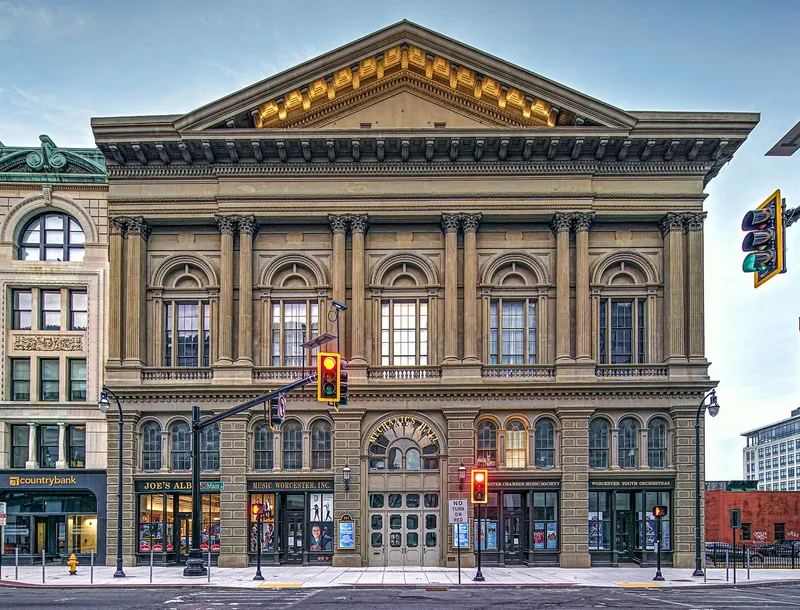
Eight commercial buildings along Main Street in downtown Worcester form this district, which is centered on Mechanics' Hall. The buildings date from 1854 to 1925 and show the range of commercial architecture in the city: Italianate Flagg's Building of 1854, the Romanesque Revival Five Cent Savings Bank of 1891, the Burnside and Day buildings, the limestone Central Exchange Building, the nine-storey marble State Mutual Building of 1894-1897, which was Worcester's first skyscraper, and the classical Central Building of 1925. Mechanics' Hall, built 1855-1857 to designs by Elbridge Boyden, is a major local landmark with an early concert hall. The district was drawn to include row buildings on both sides of the hall, preserving the dense setting for which it was designed. Demolitions over the previous twenty years had fragmented similar rows elsewhere on Main Street, which made this stretch one of the last to keep that character. A vacant lot beside the hall is the only intrusion.
Machine-generated summary. This summary was generated by a language model from the official nomination document and has not been reviewed line by line by an editor. It may contain errors. Check the source document before relying on any detail. Source: nomination document (PDF) · catalog entry. Generated October 2026 (model claude-sonnet-5-5, prompt v1.0-2026-10-29).
| Period of significance | 1854-1925 |
|---|---|
| Styles | Mixed Victorian and 20th century: Italianate, Romanesque Revival, Renaissance Revival, eclectic Classical and Classical Revival |
| Areas of significance | Commerce, Architecture |
| Acreage | 4 |
| Boundary source | not published |
| Full listing page | Mechanics' Hall District (property record) |
What listing means for this property
This is a historic district. Buildings within its boundary are either contributing (they add to the district's significance) or non-contributing. Owners of contributing income-producing buildings can claim the 20% federal rehabilitation tax credit; homeowners should look at state credits. National Register districts impose no design review by themselves; a local historic district ordinance, if one exists, does (the difference explained).
General information, not legal or tax advice. Rules change; confirm with your State Historic Preservation Office or a qualified adviser.