Market Square Historic District

The National Park Service has not published a boundary polygon for this district; the map shows the listed properties inside it and the district's reference point.
Why it's listed
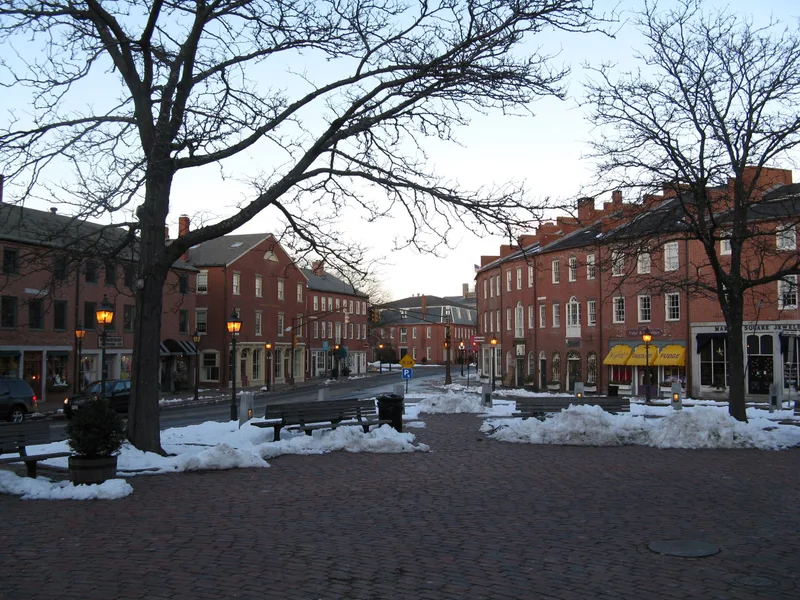
Market Square in Newburyport, Massachusetts, is a triangular open space where State, Water and Merrimac Streets meet beside the Merrimack River. Around it stands a district of about 6.2 acres, made up mostly of three-story brick row buildings with shops below and dwellings above. A fire on May 31, 1811, destroyed nearly the whole area, and a state act required that new buildings be brick or stone. Most of the square was rebuilt over the next twenty-one years under that rule, giving the streets a consistent Federal-style look, with massive fire walls ending in stepped gables. Two buildings stand out: the brick Market House begun in 1823, later converted to a fire station, and the Custom House of 1834-35, designed by Robert Mills. The square was the center of the port's shipbuilding, fishing, trading and distilling economy. Some buildings were owned by a redevelopment authority and stood empty and deteriorated awaiting restoration, while privately owned shops remained in use.
Machine-generated summary. This summary was generated by a language model from the official nomination document and has not been reviewed line by line by an editor. It may contain errors. Check the source document before relying on any detail. Source: nomination document (PDF) · catalog entry. Generated October 2026 (model claude-sonnet-5-5, prompt v1.0-2026-10-29).
| Period of significance | 1811-1832 |
|---|---|
| Styles | Federal style; Custom House described as classical revival |
| Areas of significance | Commerce, Architecture |
| Acreage | 6.2 |
| Boundary source | not published |
| Full listing page | Market Square Historic District (property record) |
What listing means for this property
This is a historic district. Buildings within its boundary are either contributing (they add to the district's significance) or non-contributing. Owners of contributing income-producing buildings can claim the 20% federal rehabilitation tax credit; homeowners should look at state credits. National Register districts impose no design review by themselves; a local historic district ordinance, if one exists, does (the difference explained).
General information, not legal or tax advice. Rules change; confirm with your State Historic Preservation Office or a qualified adviser.