Main Street Historic District

Why it's listed
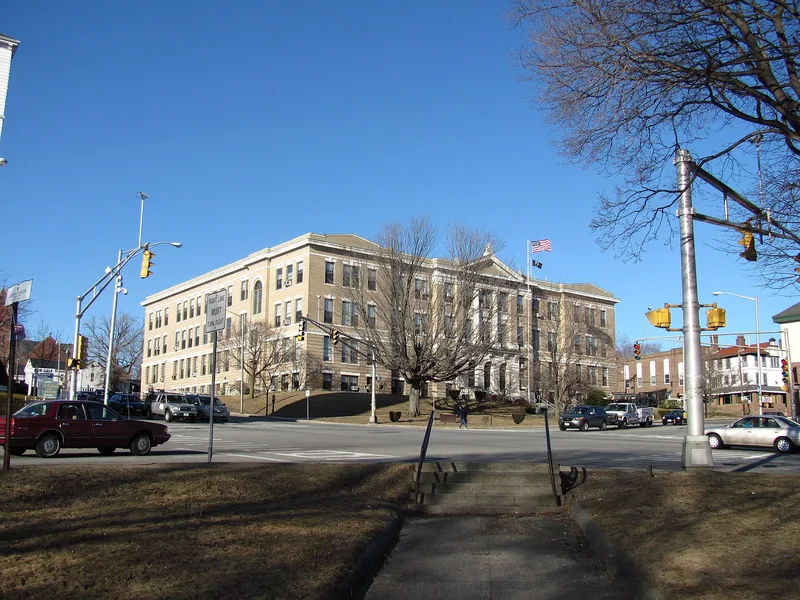
Main Street Historic District is a stretch of Haverhill's main corridor, running north uphill from the Merrimack River. It begins at the old town common, now Grand Army of the Republic Park, which holds a band shell, a fountain, a cannon and several war memorials, including the 1879 Hannah Dustin Monument. North of the park stand two churches from the mid-1800s and 1880s, among them the 1847-48 Romanesque Revival church designed by Alpheus Cary Morse, later turned to face Main Street and now an Armenian Apostolic church. The 1909 Beaux-Arts Classical high school was converted to City Hall in the 1970s. Other buildings include the 1883 First Baptist Church with its 140-foot tower, the First Congregational Church of 1859 remodeled in 1916, and the 1953 Wadleigh Home. Large houses built for town leaders now serve commercial uses. The area reflects the common's colonial role as meetinghouse site and training field, and the later growth of Haverhill's civic and religious center.
Machine-generated summary. This summary was generated by a language model from the official nomination document and has not been reviewed line by line by an editor. It may contain errors. Check the source document before relying on any detail. Source: nomination document (PDF) · catalog entry. Generated October 2026 (model claude-sonnet-5-5, prompt v1.0-2026-10-29).
| Styles | Romanesque Revival, Stick, Italianate, Greek Revival, Renaissance Revival, Classical Revival, Colonial Revival |
|---|---|
| Areas of significance | Architecture, Community Planning and Development, Religion, Education, Politics/Government |
| Acreage | 13 |
| Boundary source | NPS cultural-resource GIS polygon |
| Full listing page | Main Street Historic District (property record) |
What listing means for this property
This is a historic district. Buildings within its boundary are either contributing (they add to the district's significance) or non-contributing. Owners of contributing income-producing buildings can claim the 20% federal rehabilitation tax credit; homeowners should look at state credits. National Register districts impose no design review by themselves; a local historic district ordinance, if one exists, does (the difference explained).
General information, not legal or tax advice. Rules change; confirm with your State Historic Preservation Office or a qualified adviser.