Lower Roxbury Historic District

Why it's listed
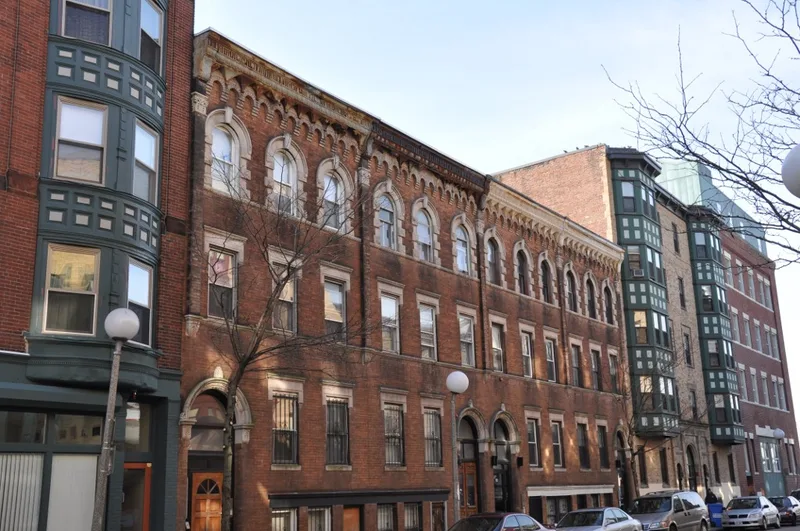
Lower Roxbury Historic District is a compact Boston neighborhood of about 3.2 acres where Tremont Street, Columbus Avenue, Cunard Street and Walpole Street frame a dense cluster of 36 brick buildings. Most are three- to five-story apartment blocks in red, buff or yellow brick, built mainly between 1894 and 1900, with Classical Revival cornices and angled metal-clad bay windows. Storefronts occupy the ground floors along the two main avenues, while side streets are entirely residential. The area was once filled marshland and a mix of factories and frame worker housing. Fire regulations introduced in 1885 required brick construction, and the widening of Columbus Avenue in the 1890s led to the demolition of all frame buildings, which were replaced by the masonry buildings now standing. Boston-area architects experienced in multi-family design shaped the streetscape. The earliest building is a Greek Revival/Italianate structure at 1011-1019 Tremont Street, likely from the 1850s. The district is listed for its architecture and its role in the area's redevelopment.
Machine-generated summary. This summary was generated by a language model from the official nomination document and has not been reviewed line by line by an editor. It may contain errors. Check the source document before relying on any detail. Source: nomination document (PDF) · catalog entry. Generated October 2026 (model claude-sonnet-5-5, prompt v1.0-2026-10-29).
| Period of significance | ca. 1850-1944 |
|---|---|
| Styles | Late Victorian: Renaissance; Late 19th and 20th Century Revivals: Classical Revival, Gothic Revival |
| Areas of significance | Architecture, Community Planning and Development |
| Acreage | 3.2 |
| Boundary source | NPS cultural-resource GIS polygon |
| Full listing page | Lower Roxbury Historic District (property record) |
What listing means for this property
This is a historic district. Buildings within its boundary are either contributing (they add to the district's significance) or non-contributing. Owners of contributing income-producing buildings can claim the 20% federal rehabilitation tax credit; homeowners should look at state credits. National Register districts impose no design review by themselves; a local historic district ordinance, if one exists, does (the difference explained).
General information, not legal or tax advice. Rules change; confirm with your State Historic Preservation Office or a qualified adviser.