Lincoln Center Historic District

Why it's listed
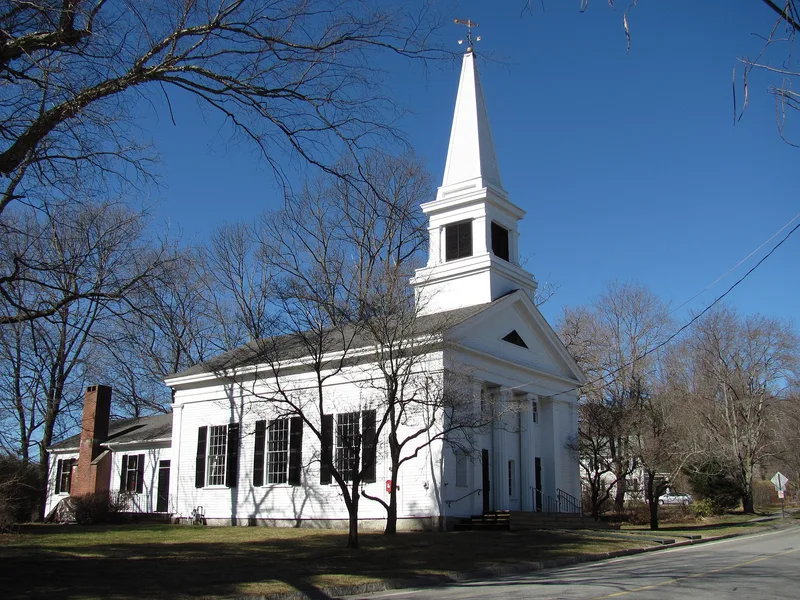
Lincoln Center is a 161-acre village core at the geographic center of Lincoln, Massachusetts, about 15 miles west of Boston. Six roads radiate from a central watering trough, lined with 59 buildings that are almost all residential, along with two churches, a library, two town halls, a school, a town common and two burying grounds. Stone walls, hedges, orchards, hay fields and large house lots preserve a rural feel. The buildings trace local history from the Georgian Brown-Russell-Chapin House of 1734-1754 through Federal homes such as the Samuel Hoar House, Greek Revival houses and the 1848 Old Town Hall, to Victorian Romanesque landmarks like the 1883-1884 library and 1891 Stone Church, and Colonial Revival estates. The district was listed because it shows the growth of Lincoln's center from early 18th century settlement into a well-to-do suburban enclave while keeping its village scale and open land.
Machine-generated summary. This summary was generated by a language model from the official nomination document and has not been reviewed line by line by an editor. It may contain errors. Check the source document before relying on any detail. Source: nomination document (PDF) · catalog entry. Generated October 2026 (model claude-sonnet-5-5, prompt v1.0-2026-10-29).
| Period of significance | 1747-1930 |
|---|---|
| Styles | Georgian, Federal, Greek Revival, Italianate, Second Empire, Queen Anne, Georgian Revival, Colonial Revival, Victorian Romanesque |
| Areas of significance | Community Planning and Development, Landscape Architecture, Agriculture, Conservation, Education, Politics/Government, Architecture, Religion |
| Acreage | 161.4 |
| Boundary source | NPS cultural-resource GIS polygon |
| Full listing page | Lincoln Center Historic District (property record) |
What listing means for this property
This is a historic district. Buildings within its boundary are either contributing (they add to the district's significance) or non-contributing. Owners of contributing income-producing buildings can claim the 20% federal rehabilitation tax credit; homeowners should look at state credits. National Register districts impose no design review by themselves; a local historic district ordinance, if one exists, does (the difference explained).
General information, not legal or tax advice. Rules change; confirm with your State Historic Preservation Office or a qualified adviser.