L.H. Hamel Leather Company Historic District

Why it's listed
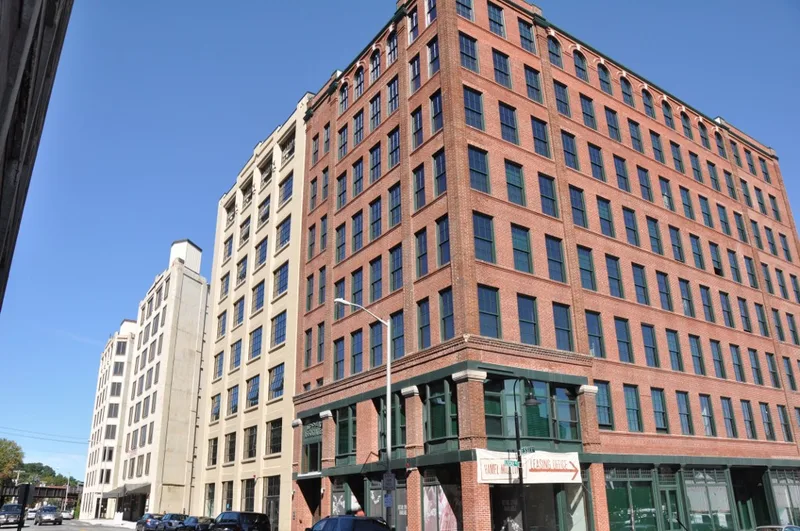
This group of early 20th-century factory buildings sits at the western edge of downtown Haverhill, Massachusetts, between Essex, Locke, Duncan and Winter Streets and the old railroad corridor. Built between about 1886 and 1929, it includes five eight-story buildings, a seven-story building, a late 19th-century warehouse, and a 1920s power plant with a smokestack painted with the L. H. Hamel Leather Co. name. The large buildings show a change in industrial design during the 1910s. Some, such as the Pentucket Associates and Essex Associates Buildings, are brick Classical Revival blocks. Others, including the Burgess, Lang and Tilton Buildings, are Moderne structures of reinforced concrete with minimal ornament. The Shoe and Leather Associates Building of 1918 uses curtain-wall construction. The complex is one of the largest intact tracts of historic industrial buildings in Haverhill, a city whose economy depended heavily on shoe manufacturing in the early 20th century. Much of the surrounding area lost its older buildings to demolition in the late 20th century.
Machine-generated summary. This summary was generated by a language model from the official nomination document and has not been reviewed line by line by an editor. It may contain errors. Check the source document before relying on any detail. Source: nomination document (PDF) · catalog entry. Generated October 2026 (model claude-sonnet-5-5, prompt v1.0-2026-10-29).
| Styles | Classical Revival; Moderne |
|---|---|
| Areas of significance | Architecture, Industry, Community Planning and Development |
| Acreage | 6 |
| Boundary source | NPS cultural-resource GIS polygon |
| Full listing page | L.H. Hamel Leather Company Historic District (property record) |
What listing means for this property
This is a historic district. Buildings within its boundary are either contributing (they add to the district's significance) or non-contributing. Owners of contributing income-producing buildings can claim the 20% federal rehabilitation tax credit; homeowners should look at state credits. National Register districts impose no design review by themselves; a local historic district ordinance, if one exists, does (the difference explained).
General information, not legal or tax advice. Rules change; confirm with your State Historic Preservation Office or a qualified adviser.