Island Grove Park National Register District

Why it's listed
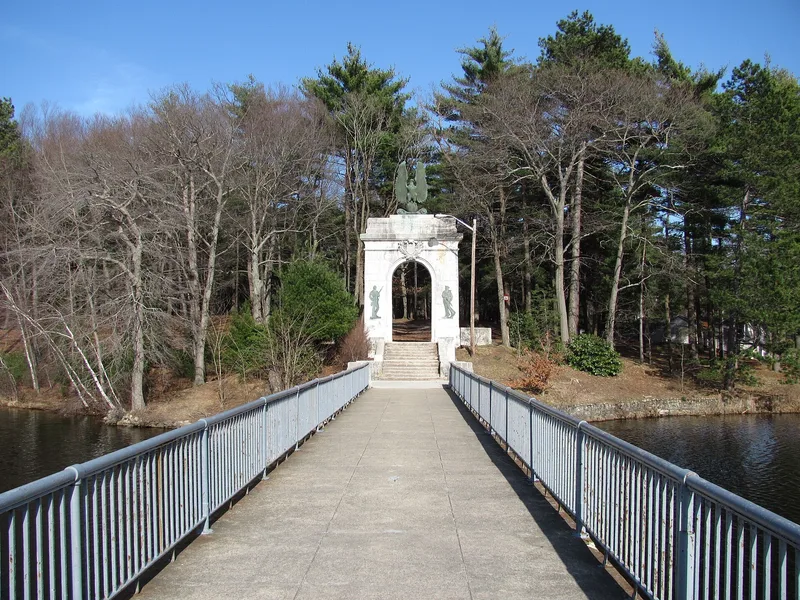
Island Grove Park in Abington, Massachusetts, is a wooded peninsula reaching into Island Grove Pond, a 35-acre pond created around 1700 when the Shumatuscacant River was dammed to power a sawmill. The district follows the municipal park boundaries and includes 22 contributing resources, among them a 1912 Memorial Bridge and Arch, a 1920 bandstand base, a 1931 refreshment stand, an 1893 gazebo, stone walls, gate posts and a drainage system. Most buildings are small wood-frame structures with rustic Craftsman details such as exposed rafter ends and fieldstone foundations. The site matters chiefly for its role in the abolition movement: from the 1840s, large crowds gathered in a natural amphitheater to hear speakers including William Lloyd Garrison and Wendell Phillips, and at least fifty meetings were recorded. Later uses included amusement grounds and a public park. The pine-covered landscape, replanted after the 1938 hurricane, still resembles early photographs, and the period of significance runs to 1951.
Machine-generated summary. This summary was generated by a language model from the official nomination document and has not been reviewed line by line by an editor. It may contain errors. Check the source document before relying on any detail. Source: nomination document (PDF) · catalog entry. Generated October 2026 (model claude-sonnet-5-5, prompt v1.0-2026-10-29).
| Period of significance | 1840s-1951 |
|---|---|
| Styles | Beaux Arts (Memorial Arch); Craftsman (buildings) |
| Areas of significance | Architecture, Entertainment/Recreation, Social History |
| Acreage | 53 |
| Boundary source | NPS cultural-resource GIS polygon |
| Full listing page | Island Grove Park National Register District (property record) |
What listing means for this property
This is a historic district. Buildings within its boundary are either contributing (they add to the district's significance) or non-contributing. Owners of contributing income-producing buildings can claim the 20% federal rehabilitation tax credit; homeowners should look at state credits. National Register districts impose no design review by themselves; a local historic district ordinance, if one exists, does (the difference explained).
General information, not legal or tax advice. Rules change; confirm with your State Historic Preservation Office or a qualified adviser.