Institutional District

Why it's listed
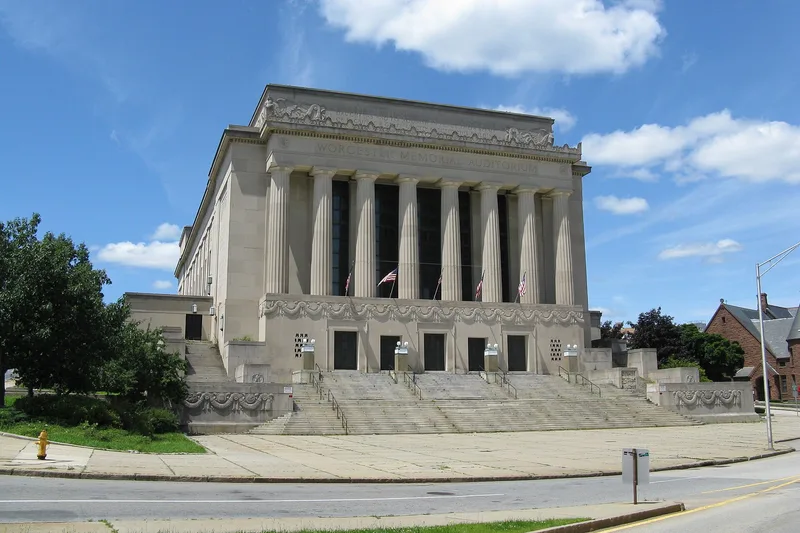
Lincoln and Armory Squares in Worcester form a concentrated group of public and institutional buildings put up between about 1843 and 1935. The district includes the granite Worcester County Courthouse, begun in 1843-1845 in Greek Revival style and enlarged in 1898-1899. It also holds the Worcester War Memorial and its Classical Revival Auditorium, the Romanesque Revival Central Church, Historical Society building, National Guard Armory and North High School, the Worcester Woman's Club designed by Josephine Wright Chapman, the Boys' Club, the trade school, and the Worcester Art Museum. Much of the area's character came from Stephen Salisbury III, whose family owned most of the land. He sold or donated sites to many of these institutions, and his estate later supplied lots for twentieth-century buildings. Although the area was never formally planned, it now holds the city's densest collection of public buildings and several major local examples of Revival-style architecture, most of them still in good, largely original condition.
Machine-generated summary. This summary was generated by a language model from the official nomination document and has not been reviewed line by line by an editor. It may contain errors. Check the source document before relying on any detail. Source: nomination document (PDF) · catalog entry. Generated October 2026 (model claude-sonnet-5-5, prompt v1.0-2026-10-29).
| Period of significance | ca. 1843-1935 |
|---|---|
| Styles | Mixed Victorian and 20th-century: Greek Revival, Romanesque Revival, Classical Revival, Georgian Revival |
| Areas of significance | Community Planning and Development, Architecture |
| Acreage | 16 |
| Boundary source | NPS cultural-resource GIS polygon |
| Full listing page | Institutional District (property record) |
What listing means for this property
This is a historic district. Buildings within its boundary are either contributing (they add to the district's significance) or non-contributing. Owners of contributing income-producing buildings can claim the 20% federal rehabilitation tax credit; homeowners should look at state credits. National Register districts impose no design review by themselves; a local historic district ordinance, if one exists, does (the difference explained).
General information, not legal or tax advice. Rules change; confirm with your State Historic Preservation Office or a qualified adviser.