Inman Square Historic District

The National Park Service has not published a boundary polygon for this district; the map shows the listed properties inside it and the district's reference point.
Why it's listed
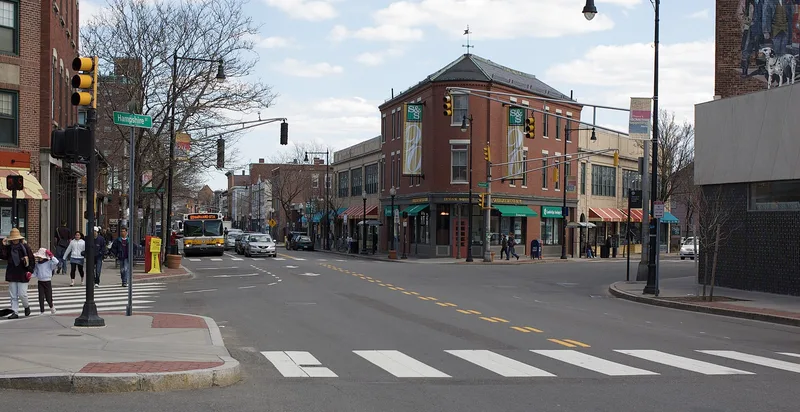
Inman Square, once called Atwood's Corner until 1875, is a compact commercial district in Cambridge at the meeting of Hampshire, Cambridge and Inman Streets. It is described as the only nineteenth-century commercial square in the city that remains virtually intact. Four buildings define it. The Waite Building (1855-57) was built for Charles Waite, a dry goods importer and major local landowner, and occupies a triangular lot. The Middlesex Bank Building (1874) is a large, prominent reminder of the square's late-century commercial activity. The Queen Anne block of 1894 has four storefronts below apartments, with patterned shingles, decorated bargeboards and original display windows. The 1912 Fire Station carries terra cotta panels tracing the history of fire fighting equipment, and it housed the city's first motor-driven apparatus. Together these buildings preserve the look of a New England commercial center, which is the basis for the district's recognition.
Machine-generated summary. This summary was generated by a language model from the official nomination document and has not been reviewed line by line by an editor. It may contain errors. Check the source document before relying on any detail. Source: nomination document (PDF) · catalog entry. Generated October 2026 (model claude-sonnet-5-5, prompt v1.0-2026-10-29).
| Period of significance | 1855-1900 |
|---|---|
| Styles | Mixed styles, including Greek Revival commercial and Queen Anne |
| Areas of significance | Architecture |
| Acreage | 1.8 |
| Boundary source | not published |
| Full listing page | Inman Square Historic District (property record) |
What listing means for this property
This is a historic district. Buildings within its boundary are either contributing (they add to the district's significance) or non-contributing. Owners of contributing income-producing buildings can claim the 20% federal rehabilitation tax credit; homeowners should look at state credits. National Register districts impose no design review by themselves; a local historic district ordinance, if one exists, does (the difference explained).
General information, not legal or tax advice. Rules change; confirm with your State Historic Preservation Office or a qualified adviser.