Houghton Street Historic District

Why it's listed
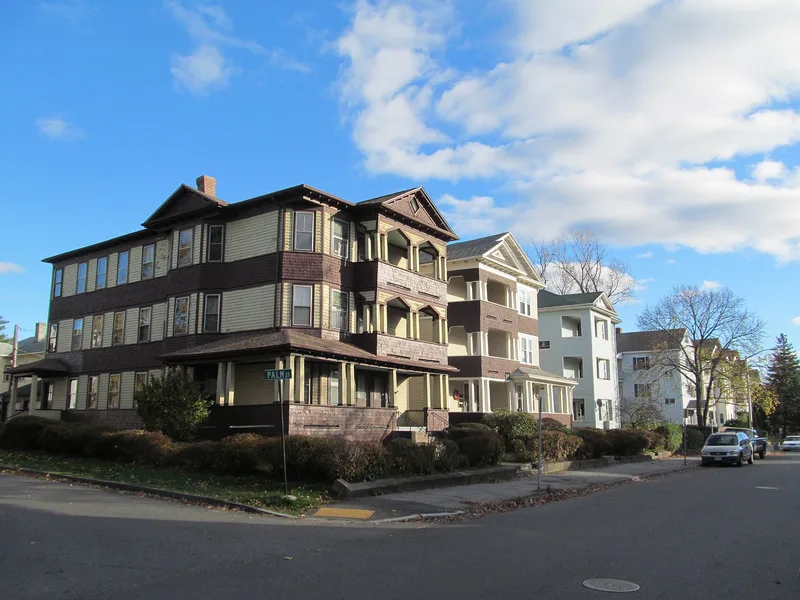
Houghton Street Historic District is a compact group of seven three-decker houses and three cinder block garages in Worcester's Grafton Hill area, built between about 1920 and 1926. The houses are Colonial Revival in style and are notable for their ornate detailing, unusual massing and three-tier front porches, many with pedimented gables, brackets and stained-glass bay windows. Only 63 Houghton Street has lost its integrity, because of modern siding. The district reflects the eastward spread of three-decker construction along the Grafton Street corridor in the 1920s. Its early residents were skilled blue-collar and white-collar families who moved from the city's older East Side neighborhoods. In 1930 most residents were members of the Jewish community, with Irish, French-Canadian and Armenian families also living there. The district is regarded as one of the best surviving collections of ornate Colonial Revival three-deckers in the city, and it was listed for its architecture and its place in Worcester's suburban housing development.
Machine-generated summary. This summary was generated by a language model from the official nomination document and has not been reviewed line by line by an editor. It may contain errors. Check the source document before relying on any detail. Source: nomination document (PDF) · catalog entry. Generated October 2026 (model claude-sonnet-5-5, prompt v1.0-2026-10-29).
| Period of significance | ca. 1920-1926 |
|---|---|
| Styles | Colonial Revival |
| Areas of significance | Community Planning and Development, European, Architecture, Social History |
| Acreage | 1.1 |
| Boundary source | NPS cultural-resource GIS polygon |
| Full listing page | Houghton Street Historic District (property record) |
What listing means for this property
This is a historic district. Buildings within its boundary are either contributing (they add to the district's significance) or non-contributing. Owners of contributing income-producing buildings can claim the 20% federal rehabilitation tax credit; homeowners should look at state credits. National Register districts impose no design review by themselves; a local historic district ordinance, if one exists, does (the difference explained).
General information, not legal or tax advice. Rules change; confirm with your State Historic Preservation Office or a qualified adviser.