Hollander Blocks

The National Park Service has not published a boundary polygon for this district; the map shows the listed properties inside it and the district's reference point.
Why it's listed
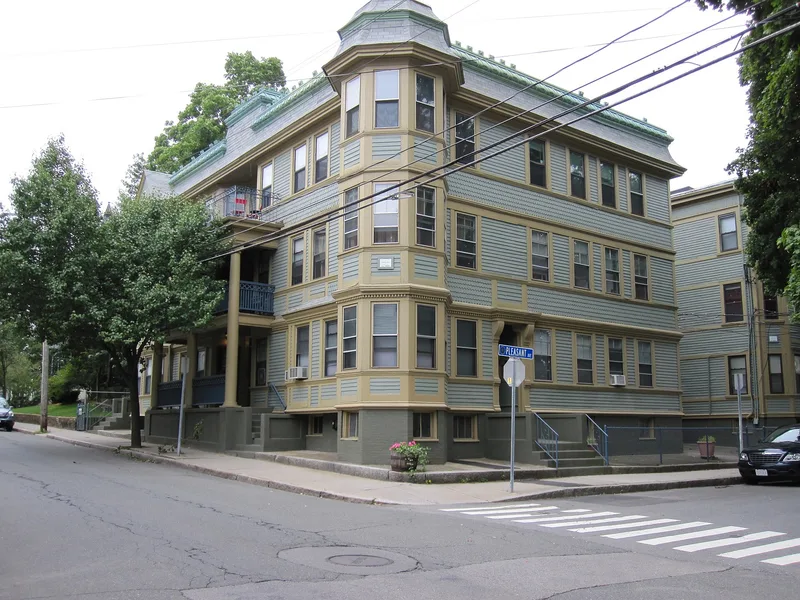
Two apartment houses stand together on a corner lot on Prospect Hill in Somerville, one facing Walnut Street and one facing Pleasant Avenue. Built around 1890, they are Queen Anne in style, with Colonial Revival touches seen in their symmetry, abbreviated hipped roofs topped by elaborate copper cresting, and three-decker porches with simple balustrades and Tuscan-like columns. Clapboard siding is broken by wide bands of decorative shingles that mark the three stories. The land was part of an 1870 subdivision of Pleasant Avenue, later passed to Charles B. Hollander and then to his heirs. Investor T. Clarence Hollander built the 10-unit block at 56-58 Walnut Street and the 12-unit house at 4-6 Pleasant Avenue by 1895, answering a sharp rise in housing demand. The buildings retain their original character and anchor a neighborhood of mainly single and two-family homes, which is why they were recognized for architectural and local historical value.
Machine-generated summary. This summary was generated by a language model from the official nomination document and has not been reviewed line by line by an editor. It may contain errors. Check the source document before relying on any detail. Source: nomination document (PDF) · catalog entry. Generated October 2026 (model claude-sonnet-5-5, prompt v1.0-2026-10-29).
| Styles | Queen Anne with Colonial Revival features |
|---|---|
| Areas of significance | Community Planning and Development, Architecture |
| Acreage | 0.9 |
| Boundary source | not published |
| Full listing page | Hollander Blocks (property record) |
What listing means for this property
This is a historic district. Buildings within its boundary are either contributing (they add to the district's significance) or non-contributing. Owners of contributing income-producing buildings can claim the 20% federal rehabilitation tax credit; homeowners should look at state credits. National Register districts impose no design review by themselves; a local historic district ordinance, if one exists, does (the difference explained).
General information, not legal or tax advice. Rules change; confirm with your State Historic Preservation Office or a qualified adviser.