Hastings Square Historic District

Why it's listed
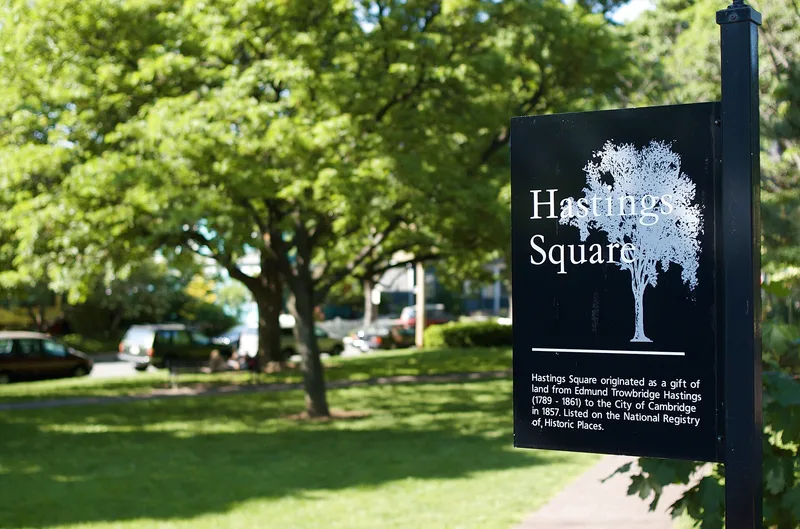
Hastings Square and adjacent Henry Street form a compact residential neighborhood in Cambridgeport, Cambridge, on a low rise above the Charles River. The Dana heirs conceived the square in the 1830s, and after a revised plan, houses began going up in 1852. The opening of the Cottage Farm Bridge, now the Boston University Bridge, made the area a desirable place to live. Large Queen Anne dwellings face the park on all four sides, with Italianate, Mansard and Shingle Style houses adding variety. Early residents in the 1860s included a tailor, a carpenter and a builder, while later, more elaborate houses were built for prosperous businessmen such as an organ manufacturer and a Faneuil Hall merchant. Examples include 75 Henry Street, designed by Hartwell and Richardson in 1892, and 302 Brookline Avenue, by Rand & Taylor in 1887. The district was recognized for its coherent late nineteenth century architecture around an open square.
Machine-generated summary. This summary was generated by a language model from the official nomination document and has not been reviewed line by line by an editor. It may contain errors. Check the source document before relying on any detail. Source: nomination document (PDF) · catalog entry. Generated October 2026 (model claude-sonnet-5-5, prompt v1.0-2026-10-29).
| Period of significance | 1860-1890 |
|---|---|
| Styles | Queen Anne, with Bracketed Italianate, Bracketed Mansard and Shingle Style examples |
| Areas of significance | Architecture |
| Acreage | 5 |
| Boundary source | NPS cultural-resource GIS polygon |
| Full listing page | Hastings Square Historic District (property record) |
What listing means for this property
This is a historic district. Buildings within its boundary are either contributing (they add to the district's significance) or non-contributing. Owners of contributing income-producing buildings can claim the 20% federal rehabilitation tax credit; homeowners should look at state credits. National Register districts impose no design review by themselves; a local historic district ordinance, if one exists, does (the difference explained).
General information, not legal or tax advice. Rules change; confirm with your State Historic Preservation Office or a qualified adviser.