Harvard Street Historic District

The National Park Service has not published a boundary polygon for this district; the map shows the listed properties inside it and the district's reference point.
Why it's listed
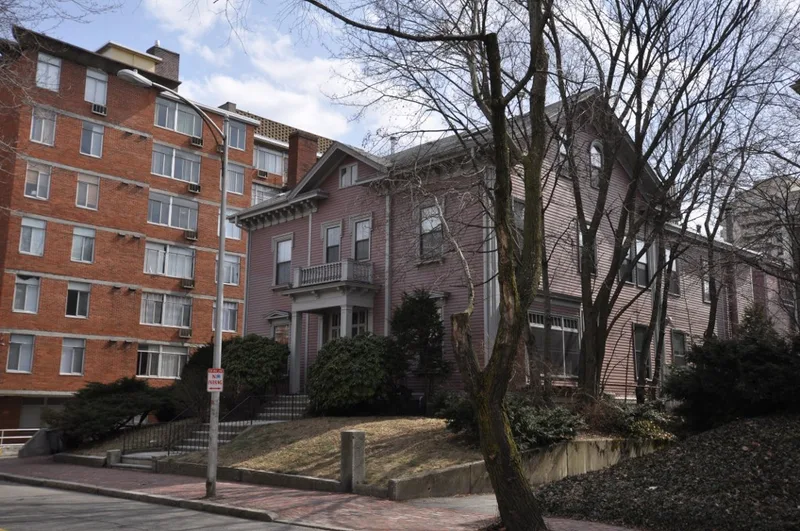
Harvard Street, at the summit of Dana Hill in Mid-Cambridge, is lined with large nineteenth-century houses built for Boston businessmen moving to the suburbs. The district covers about two acres between Ellery and Hancock Streets. Its houses date from 1850 to 1897 and show a sequence of styles: a wide-pilastered Greek Revival mansion at 335, a brick Italianate double house at 341-43, a Bracketed-Italianate house at 336, a pattern-book Gothic house at 338, a Mansard house at 342-44, and Colonial Revival houses at 337 and 340 designed by James P. Kelley and Arthur Vinal. The street was laid out as a direct route from Old Cambridge to Boston, over the objections of Judge Francis Dana, and by 1896 it was among the city's handsomest streets. Apartment buildings arrived in the 1920s and 1960s, yet the street retains much of its original appearance. The boundaries were drawn to include the large residences that once distinguished it.
Machine-generated summary. This summary was generated by a language model from the official nomination document and has not been reviewed line by line by an editor. It may contain errors. Check the source document before relying on any detail. Source: nomination document (PDF) · catalog entry. Generated October 2026 (model claude-sonnet-5-5, prompt v1.0-2026-10-29).
| Styles | Greek Revival, Italianate, Gothic Revival, Mansard, Colonial Revival |
|---|---|
| Areas of significance | Architecture |
| Acreage | 2 |
| Boundary source | not published |
| Full listing page | Harvard Street Historic District (property record) |
What listing means for this property
This is a historic district. Buildings within its boundary are either contributing (they add to the district's significance) or non-contributing. Owners of contributing income-producing buildings can claim the 20% federal rehabilitation tax credit; homeowners should look at state credits. National Register districts impose no design review by themselves; a local historic district ordinance, if one exists, does (the difference explained).
General information, not legal or tax advice. Rules change; confirm with your State Historic Preservation Office or a qualified adviser.