Harvard Square Historic District

The National Park Service has not published a boundary polygon for this district; the map shows the listed properties inside it and the district's reference point.
Why it's listed
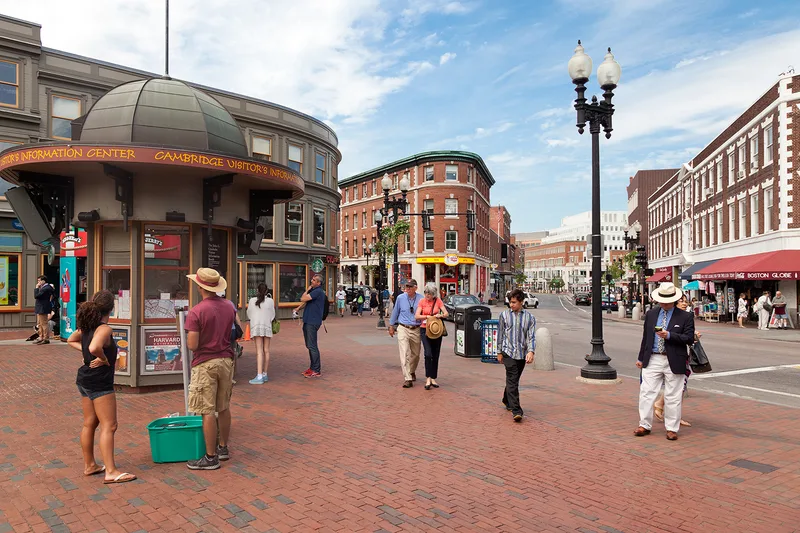
Harvard Square, at the meeting of Massachusetts Avenue, Boylston Street and Brattle Street in Cambridge, is a compact commercial district of mixed architectural styles built between 1782 and 1908. Its most prominent building is a block at Massachusetts Avenue and Boylston Street that combines the three oldest commercial buildings in Cambridge, including a tailor shop and two late eighteenth-century houses, unified behind a common facade in 1896. Nearby are the early Greek Revival Farwell tenant house of 1820, the Georgian Revival Abbott Building of 1908 on a triangular lot that follows the seventeenth-century street pattern, and Graduates Hall, begun in 1832 and later extended to 260 feet. Built as a brick dormitory with shops below, Graduates Hall pioneered the private dormitory in the Square. The district boundaries were drawn to capture buildings linked to the area's commercial and transportation role, and they include the street space of the Square itself along with the 1977-listed subway kiosk.
Machine-generated summary. This summary was generated by a language model from the official nomination document and has not been reviewed line by line by an editor. It may contain errors. Check the source document before relying on any detail. Source: nomination document (PDF) · catalog entry. Generated October 2026 (model claude-sonnet-5-5, prompt v1.0-2026-10-29).
| Period of significance | 1782-1908 |
|---|---|
| Styles | Mixed styles, including Greek Revival and Georgian Revival |
| Areas of significance | Architecture |
| Acreage | 1.9 |
| Boundary source | not published |
| Full listing page | Harvard Square Historic District (property record) |
What listing means for this property
This is a historic district. Buildings within its boundary are either contributing (they add to the district's significance) or non-contributing. Owners of contributing income-producing buildings can claim the 20% federal rehabilitation tax credit; homeowners should look at state credits. National Register districts impose no design review by themselves; a local historic district ordinance, if one exists, does (the difference explained).
General information, not legal or tax advice. Rules change; confirm with your State Historic Preservation Office or a qualified adviser.