Greenlawn Cemetery

Why it's listed
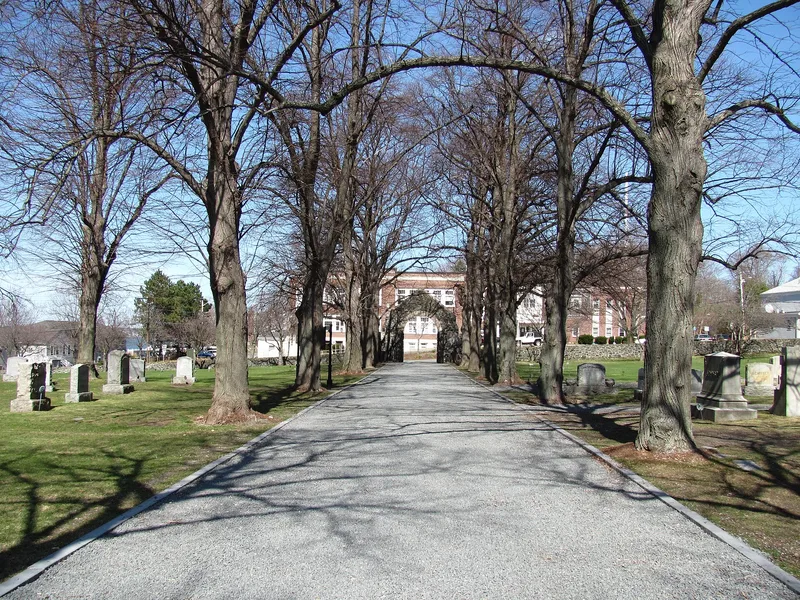
Greenlawn Cemetery occupies a southern hillside slope on Nahant Road in Nahant, Massachusetts. Established in 1856 as a two-acre parcel, it grew in four stages between 1859 and 1928 to reach 5.6 acres. Its character comes largely from a 1919-20 design by the Boston firm of Cram & Ferguson. Granite quarried in Nahant was used for Ellingwood Chapel, the tool house, perimeter walls and gates, all in a simple Norman and Gothic Revival manner. The chapel was a gift from Mary M. Johnson in memory of her husband's parents, and its windows are by Charles J. Connick. The older southern half holds varied nineteenth-century markers, a receiving tomb of 1856, and Civil War and World War I memorials, while the newer northern half is an open lawn with flush markers. The property was valued for its role in the town's development and for its architecture, with a significance period of 1856 to 1950.
Machine-generated summary. This summary was generated by a language model from the official nomination document and has not been reviewed line by line by an editor. It may contain errors. Check the source document before relying on any detail. Source: nomination document (PDF) · catalog entry. Generated October 2026 (model claude-sonnet-5-5, prompt v1.0-2026-10-29).
| Period of significance | 1856-1950 |
|---|---|
| Styles | Late Gothic Revival |
| Areas of significance | Architecture, Community Planning and Development |
| Acreage | 3.9 |
| Boundary source | NPS cultural-resource GIS polygon |
| Full listing page | Greenlawn Cemetery (property record) |
What listing means for this property
This is a historic district. Buildings within its boundary are either contributing (they add to the district's significance) or non-contributing. Owners of contributing income-producing buildings can claim the 20% federal rehabilitation tax credit; homeowners should look at state credits. National Register districts impose no design review by themselves; a local historic district ordinance, if one exists, does (the difference explained).
General information, not legal or tax advice. Rules change; confirm with your State Historic Preservation Office or a qualified adviser.