Fulton-Commercial Streets District

The National Park Service has not published a boundary polygon for this district; the map shows the listed properties inside it and the district's reference point.
Why it's listed
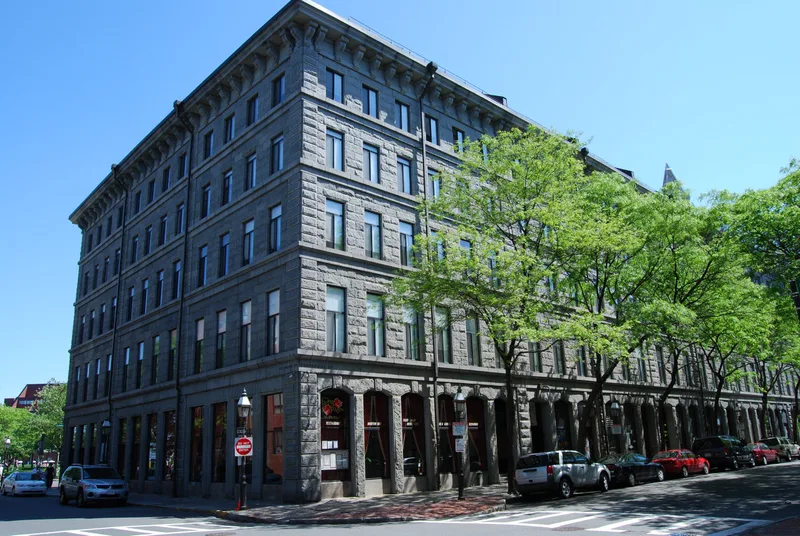
Along Fulton, Commercial, Mercantile, Lewis and Richmond Streets in Boston stands a waterfront district of about 80 brick row buildings, most built in the 1830s and 1840s. Development followed the construction of the Quincy Markets in 1825-26, when fill created new land for stores and warehouses serving the port. Three developers, Robert G. Shaw, Samuel S. Lewis and Henry Gardner, wrote height and material restrictions into deeds, so nearly all buildings are four-story brick rows with granite posts and lintels at street level. Three larger buildings anchor the district: the granite Mercantile Wharf Building of 1856, designed by Gridley J. F. Bryant; the Commercial Block of 1857; and the McLauthlin Building of about 1864, with the earliest surviving cast iron front in New England. The area declined after the 1890s and was cut off by the Fitzgerald Expressway in the 1950s. Most properties were later acquired for urban renewal and left vacant.
Machine-generated summary. This summary was generated by a language model from the official nomination document and has not been reviewed line by line by an editor. It may contain errors. Check the source document before relying on any detail. Source: nomination document (PDF) · catalog entry. Generated October 2026 (model claude-sonnet-5-5, prompt v1.0-2026-10-29).
| Period of significance | 1830's to 1860's |
|---|---|
| Styles | 19th century commercial architecture; Renaissance revival (Mercantile Wharf Building); cast iron front (McLauthlin Building) |
| Areas of significance | Commerce, Architecture |
| Acreage | 9 |
| Boundary source | not published |
| Full listing page | Fulton-Commercial Streets District (property record) |
What listing means for this property
This is a historic district. Buildings within its boundary are either contributing (they add to the district's significance) or non-contributing. Owners of contributing income-producing buildings can claim the 20% federal rehabilitation tax credit; homeowners should look at state credits. National Register districts impose no design review by themselves; a local historic district ordinance, if one exists, does (the difference explained).
Noted as vacant in the nomination. Nomination documents can be decades old; current status may differ. If you are considering buying an empty listed property, read the due-diligence checklist.
General information, not legal or tax advice. Rules change; confirm with your State Historic Preservation Office or a qualified adviser.