Fort Point Channel Historic District

Why it's listed
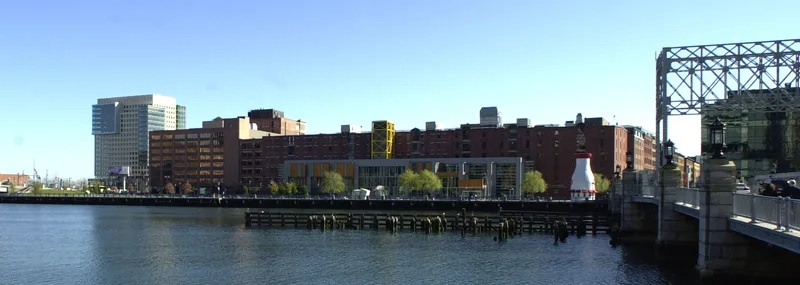
Across Fort Point Channel from downtown Boston, this 55-acre district at the northwest corner of South Boston holds 103 buildings and 11 structures, most of them brick and heavy-timber lofts built between 1880 and 1929 for warehousing and light manufacturing. All of the land was created by the Boston Wharf Company, which filled the area, laid out the streets and put up most of the buildings, largely to designs by staff architects Morton D. Safford and Howard B. Prescott. Styles range from Italianate and Romanesque Revival to the predominant Classical Revival. Four bridges cross the channel, including the 1900 Summer Street retractile draw bridge, the 1930 Congress Street bascule bridge designed by Joseph B. Strauss, and the Northern Avenue swing bridge. Summer Street's elevated grade, carried over A Street, and the curving Melcher Street give the area a distinctive character. Today the loft buildings house apartments, studios, museums and businesses.
Machine-generated summary. This summary was generated by a language model from the official nomination document and has not been reviewed line by line by an editor. It may contain errors. Check the source document before relying on any detail. Source: nomination document (PDF) · catalog entry. Generated October 2026 (model claude-sonnet-5-5, prompt v1.0-2026-10-29).
| Styles | Late 19th and early 20th century Revivals (Classical, Renaissance, Romanesque Revival); Late Victorian (Italianate, Queen Anne, Stylized Classical); Industrial utilitarian |
|---|---|
| Areas of significance | Architecture, Transportation, Commerce, Community Planning and Development, Engineering, Industry, Maritime History |
| Acreage | 55 |
| Boundary source | NPS cultural-resource GIS polygon |
| Full listing page | Fort Point Channel Historic District (property record) |
What listing means for this property
This is a historic district. Buildings within its boundary are either contributing (they add to the district's significance) or non-contributing. Owners of contributing income-producing buildings can claim the 20% federal rehabilitation tax credit; homeowners should look at state credits. National Register districts impose no design review by themselves; a local historic district ordinance, if one exists, does (the difference explained).
General information, not legal or tax advice. Rules change; confirm with your State Historic Preservation Office or a qualified adviser.