Forge Village Historic District

Why it's listed
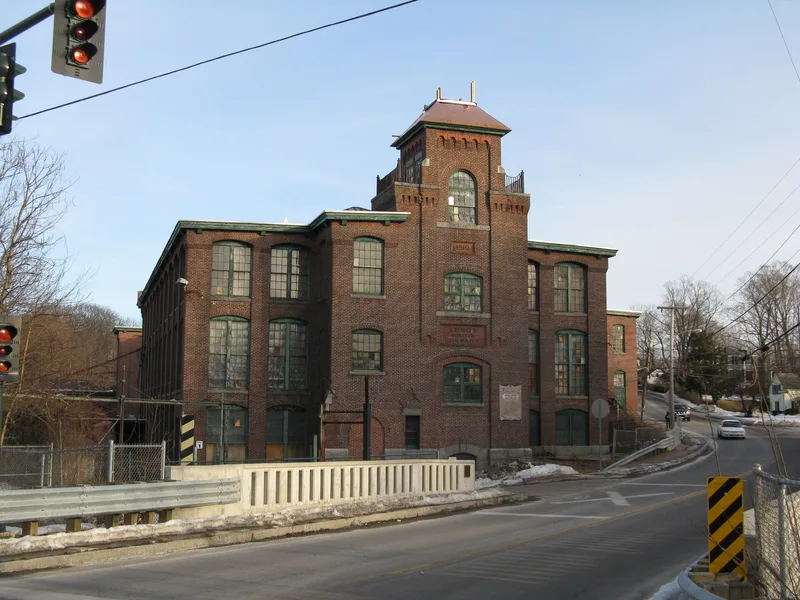
Forge Village is a mill village on Stony Brook in Westford, Massachusetts, built around the Abbot Worsted Mill. The district holds 274 historic buildings, one site and five structures, mostly single and multiple-unit houses built for factory workers. The Prescott family used the site for a grist mill and iron-making in the Colonial period. The Stony Brook Railroad arrived in 1848, and the Westford Forge Company began making axles and machined iron in 1853. Abbot Worsted took over the forge in 1879 and replaced it with the current brick mill in 1910. From about 1885 the company built worker housing, starting on Bradford Street, and recruited workers from Ireland, Scotland, Russia and other countries. It offered inexpensive homes, night classes, libraries, athletic fields and steady wages, and the mills had no strikes. Styles range from Colonial and Federal houses to Victorian Eclectic duplexes. The dense streets of company housing and the industrial streetscape on Pleasant Street give the village its character.
Machine-generated summary. This summary was generated by a language model from the official nomination document and has not been reviewed line by line by an editor. It may contain errors. Check the source document before relying on any detail. Source: nomination document (PDF) · catalog entry. Generated October 2026 (model claude-sonnet-5-5, prompt v1.0-2026-10-29).
| Styles | Colonial, Federal, Greek Revival, Victorian Eclectic, Second Empire, Queen Anne, Colonial Revival, Bungalow, Cape Cod |
|---|---|
| Areas of significance | Architecture, Community Planning and Development, Education, Industry, Transportation |
| Acreage | 250 |
| Boundary source | NPS cultural-resource GIS polygon |
| Full listing page | Forge Village Historic District (property record) |
What listing means for this property
This is a historic district. Buildings within its boundary are either contributing (they add to the district's significance) or non-contributing. Owners of contributing income-producing buildings can claim the 20% federal rehabilitation tax credit; homeowners should look at state credits. National Register districts impose no design review by themselves; a local historic district ordinance, if one exists, does (the difference explained).
General information, not legal or tax advice. Rules change; confirm with your State Historic Preservation Office or a qualified adviser.