Follen Street Historic District

Why it's listed
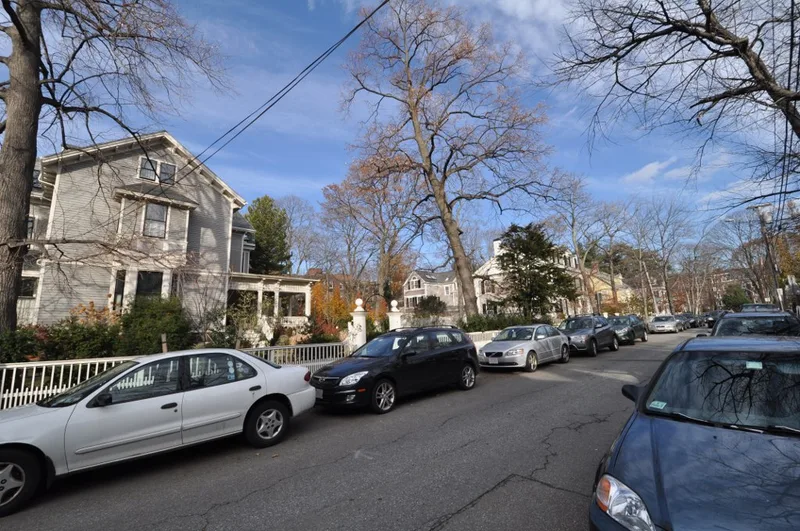
Follen Street is a quiet, shaded, single-block street in Old Cambridge, cut off from through traffic and lined with seventeen single-family houses. Laid out in sections in 1836 and 1848, it grew as building activity picked up after Cambridge's first railroad station opened. Several Greek Revival houses from 1837 to 1847 show that early phase, and later houses add Italianate, Mansard, Stick Style, Romanesque Revival and Colonial Revival designs. Architects represented include Longfellow, Alden and Harlow, Peabody and Stearns, Guy Lowell, and Warren, Smith & Biscoe. The street has long been home to Harvard professors. Josiah Dwight Whitney, for whom Mount Whitney is named, rented 29 Follen Street, where astronomers Gould and Winlock also lived and set up a small observatory. The granite house at 1 Follen Street, built in 1889, has housed the Longy School of Music since 1937. Three modern houses at the east end are included so the district covers both sides of the whole street.
Machine-generated summary. This summary was generated by a language model from the official nomination document and has not been reviewed line by line by an editor. It may contain errors. Check the source document before relying on any detail. Source: nomination document (PDF) · catalog entry. Generated October 2026 (model claude-sonnet-5-5, prompt v1.0-2026-10-29).
| Period of significance | 1837-1900 |
|---|---|
| Styles | Varied late nineteenth-century residential styles: Greek Revival, Bracketed Italianate, Mansard, Romanesque Revival, Stick Style, Colonial Revival, Neo-Georgian |
| Areas of significance | Community Planning and Development, Education, Architecture |
| Acreage | 4.9 |
| Boundary source | NPS cultural-resource GIS polygon |
| Full listing page | Follen Street Historic District (property record) |
What listing means for this property
This is a historic district. Buildings within its boundary are either contributing (they add to the district's significance) or non-contributing. Owners of contributing income-producing buildings can claim the 20% federal rehabilitation tax credit; homeowners should look at state credits. National Register districts impose no design review by themselves; a local historic district ordinance, if one exists, does (the difference explained).
General information, not legal or tax advice. Rules change; confirm with your State Historic Preservation Office or a qualified adviser.