Fay Street Historic District

The National Park Service has not published a boundary polygon for this district; the map shows the listed properties inside it and the district's reference point.
Why it's listed
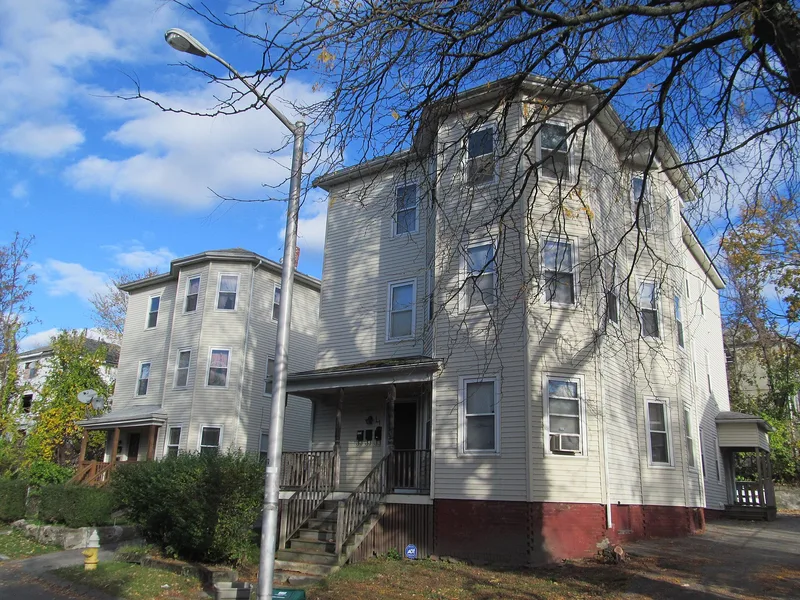
Two three-decker houses at 4 and 6 Fay Street in Worcester form a tiny district of about a quarter acre, along with a modern garage. Built around 1896, both are Queen Anne style, with hip roofs, side-hall plans, end-bay entries under projecting porches with turned posts and brackets, and three-story bay windows. They are clad in clapboard with shingle bands and retain their 2/2 sash windows. The houses were part of the northward spread of three-decker building into the Wall Street area, where workers from the Graton and Knight leather belt company, railyards, warehouses, and meat packing plants lived. The neighborhood began with Irish and French-Canadian families and later became a focus of the city's Syrian and Lebanese communities. Contractor James A. McDermott probably built the pair and owned them through 1910. The district was recognized as a well-preserved, representative example of local three-decker design and of working-class neighborhood development.
Machine-generated summary. This summary was generated by a language model from the official nomination document and has not been reviewed line by line by an editor. It may contain errors. Check the source document before relying on any detail. Source: nomination document (PDF) · catalog entry. Generated October 2026 (model claude-sonnet-5-5, prompt v1.0-2026-10-29).
| Styles | Queen Anne |
|---|---|
| Areas of significance | Community Planning and Development, European, Architecture, Social History |
| Acreage | 0.3 |
| Boundary source | not published |
| Full listing page | Fay Street Historic District (property record) |
What listing means for this property
This is a historic district. Buildings within its boundary are either contributing (they add to the district's significance) or non-contributing. Owners of contributing income-producing buildings can claim the 20% federal rehabilitation tax credit; homeowners should look at state credits. National Register districts impose no design review by themselves; a local historic district ordinance, if one exists, does (the difference explained).
General information, not legal or tax advice. Rules change; confirm with your State Historic Preservation Office or a qualified adviser.