Farnum's Gate Historic District

The National Park Service has not published a boundary polygon for this district; the map shows the listed properties inside it and the district's reference point.
Why it's listed
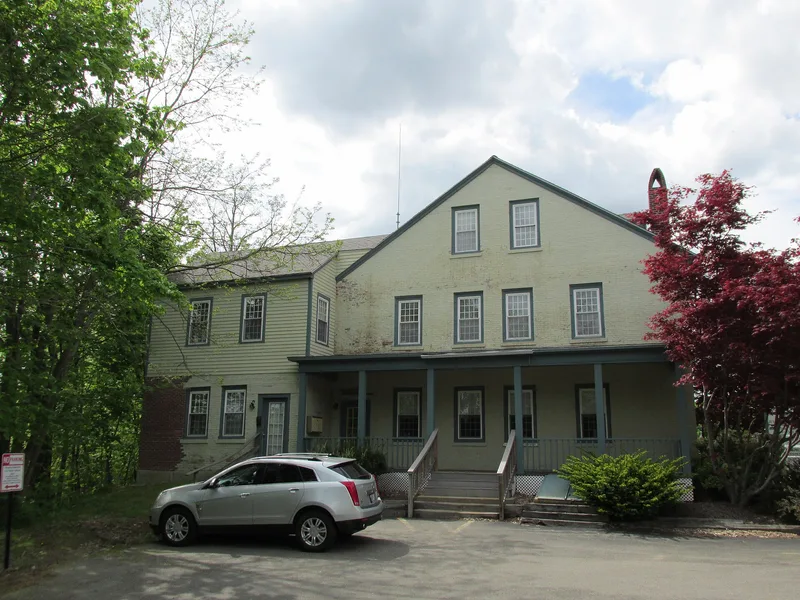
Farnum's Gate is a compact residential district at the busiest intersection in Blackstone Village, Massachusetts, next to the Blackstone River. It takes its name from the crossing used by mill owner Welcome Farnum to reach his home from his mills. Twenty-seven buildings and one stone arch bridge contribute to the district, most built between the 1830s and 1890s as homes for prosperous industrialists and later for merchants and professionals. Greek Revival is the dominant style, with examples featuring monumental columns and temple-front gables, alongside Federal, Italianate, Second Empire and Queen Anne elements. Two twentieth-century institutions, the 1920 Blackstone High School and the 1928 Federated Church, anchor the streetscape. The district also records the arrival of Irish mill workers in the 1850s, whose descendants later became local business owners and professionals. The period of significance runs from the 1829 bridge to 1945.
Machine-generated summary. This summary was generated by a language model from the official nomination document and has not been reviewed line by line by an editor. It may contain errors. Check the source document before relying on any detail. Source: nomination document (PDF) · catalog entry. Generated October 2026 (model claude-sonnet-5-5, prompt v1.0-2026-10-29).
| Period of significance | 1829-1945 |
|---|---|
| Styles | Federal, Greek Revival, Colonial Revival, Classical Revival |
| Areas of significance | Architecture, Community Planning and Development |
| Acreage | 9.6 |
| Boundary source | not published |
| Full listing page | Farnum's Gate Historic District (property record) |
What listing means for this property
This is a historic district. Buildings within its boundary are either contributing (they add to the district's significance) or non-contributing. Owners of contributing income-producing buildings can claim the 20% federal rehabilitation tax credit; homeowners should look at state credits. National Register districts impose no design review by themselves; a local historic district ordinance, if one exists, does (the difference explained).
General information, not legal or tax advice. Rules change; confirm with your State Historic Preservation Office or a qualified adviser.