East Gloucester Square Historic District

Why it's listed
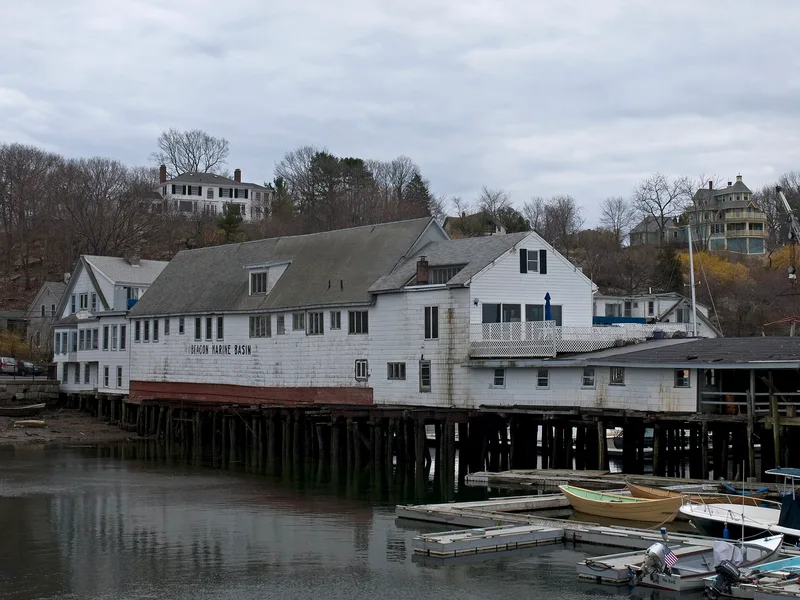
East Gloucester Square Historic District covers about 75 acres around Smith's Cove on Gloucester's Inner Harbor. Its roughly 186 contributing buildings, along with granite wharves, seawalls and retaining walls, date from about 1700 to 1945. East Main Street forms the spine, running past a small commercial node at East Gloucester Square and fish-industry complexes such as Reed & Gamage, the John F. Wonson Company Store and Gorton's. Uphill, Highland Street, Plum Street and Mount Pleasant Avenue hold modest wood-frame houses behind granite walls, with a few grander Italianate and Second Empire residences. The district matters as a compact record of the fishing economy that built Gloucester, showing homes of fishery owners and mariners beside the wharves that supported them. Its Greek Revival cottages, some with acorn-motif dentils found almost uniquely here, add architectural distinction. Good condition, strong integrity and few modern intrusions set it apart from surrounding areas.
Machine-generated summary. This summary was generated by a language model from the official nomination document and has not been reviewed line by line by an editor. It may contain errors. Check the source document before relying on any detail. Source: nomination document (PDF) · catalog entry. Generated October 2026 (model claude-sonnet-5-5, prompt v1.0-2026-10-29).
| Period of significance | 1700-1945 |
|---|---|
| Styles | Georgian, Federal, Greek Revival, Gothic Revival, Italianate, Second Empire, Queen Anne, Stick Style, Shingle Style, Colonial Revival, Craftsman |
| Areas of significance | Transportation, Commerce, Community Planning and Development, Maritime History, Architecture |
| Acreage | 75 |
| Boundary source | NPS cultural-resource GIS polygon |
| Full listing page | East Gloucester Square Historic District (property record) |
What listing means for this property
This is a historic district. Buildings within its boundary are either contributing (they add to the district's significance) or non-contributing. Owners of contributing income-producing buildings can claim the 20% federal rehabilitation tax credit; homeowners should look at state credits. National Register districts impose no design review by themselves; a local historic district ordinance, if one exists, does (the difference explained).
General information, not legal or tax advice. Rules change; confirm with your State Historic Preservation Office or a qualified adviser.