Dorchester-Milton Lower Mills Industrial District

Why it's listed
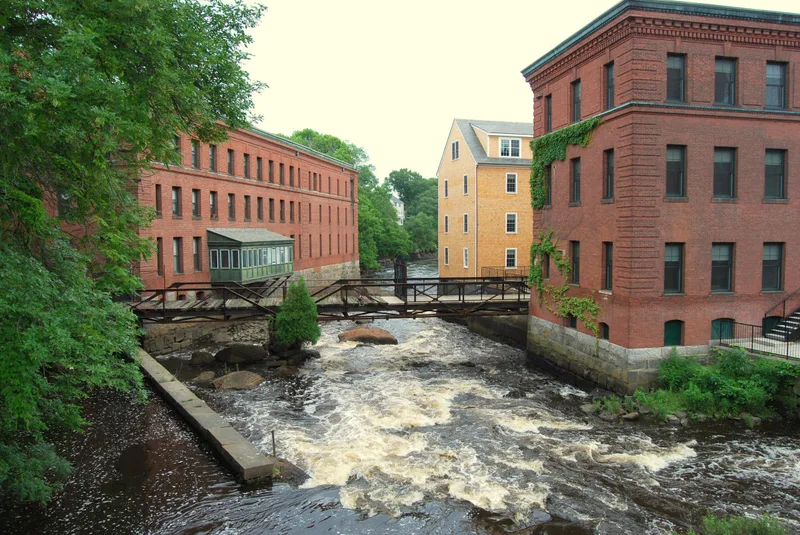
Along both banks of the Neponset River, where Boston's Dorchester neighborhood meets the town of Milton, stands a group of red brick mills built mostly between 1868 and the 1930s. Most belonged to the Walter Baker Chocolate Company, whose product grew out of water-powered chocolate making that began on the river in 1765. The district also holds the Mason Regulator Company building, a Queen Anne structure of 1888. The mills were largely designed by the firm of Nathanial J. Bradlee and its successors, and they show a progression from Second Empire to Romanesque Revival to Georgian and Renaissance Revival styles while keeping a coherent look. A power house of 1906 electrified the plant, and a concrete grain elevator painted with the Baker name is a local landmark. The site's rapids drew mill builders as early as 1634, when Israel Stoughton built a grist mill here. Baker moved its operations to Delaware in 1965, and the buildings now serve varied commercial uses.
Machine-generated summary. This summary was generated by a language model from the official nomination document and has not been reviewed line by line by an editor. It may contain errors. Check the source document before relying on any detail. Source: nomination document (PDF) · catalog entry. Generated October 2026 (model claude-sonnet-5-5, prompt v1.0-2026-10-29).
| Period of significance | 1868-1928 |
|---|---|
| Styles | Mixed: Second Empire, Romanesque Revival, Georgian Revival, Queen Anne, Art Deco |
| Areas of significance | Industry, Commerce, Architecture |
| Acreage | 20.1 |
| Boundary source | NPS cultural-resource GIS polygon |
| Full listing page | Dorchester-Milton Lower Mills Industrial District (property record) |
What listing means for this property
This is a historic district. Buildings within its boundary are either contributing (they add to the district's significance) or non-contributing. Owners of contributing income-producing buildings can claim the 20% federal rehabilitation tax credit; homeowners should look at state credits. National Register districts impose no design review by themselves; a local historic district ordinance, if one exists, does (the difference explained).
General information, not legal or tax advice. Rules change; confirm with your State Historic Preservation Office or a qualified adviser.