Concord Square Historic District

Why it's listed
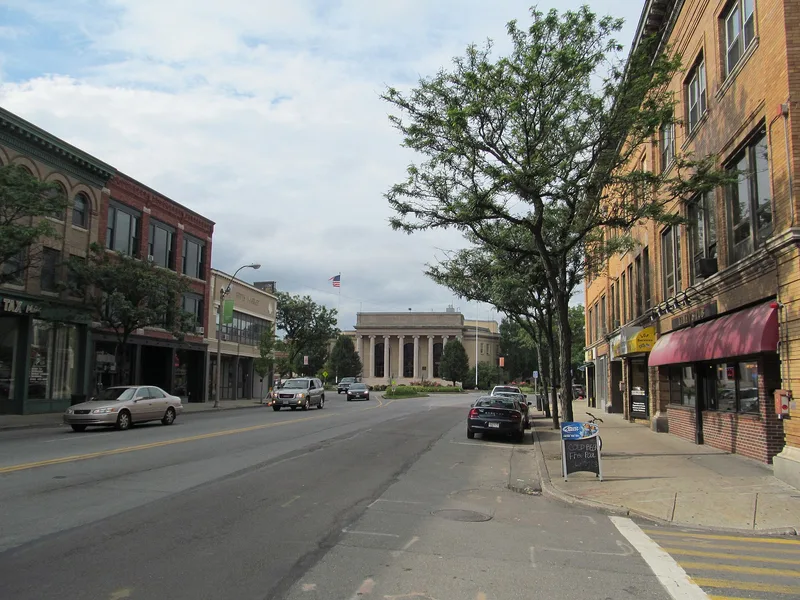
Concord Square is the downtown core of South Framingham, Massachusetts, a cluster of twenty commercial, civic and institutional buildings arranged around a small U-shaped common and the wide junction of Union Avenue and Concord Street. Most are two- to four-story masonry buildings from 1890 to 1930, designed in Classical Revival styles. Its growth followed the arrival of the Boston and Worcester railroad in 1834, which shifted activity from Framingham Center to South Framingham. Notable buildings include the 1855 Park Street Baptist Church, the Barber Straw Shop, the Concord Block by Peabody and Stearns, the 1898 Hotel Kendall, the 1927 Memorial Building with its Ionic portico, two banks by Thomas M. James, and the 1930 post office. Together they show how the village became the town's business and government center, and how a small urban commercial district was built over about forty years. Storefronts have been altered, but upper stories largely survive.
Machine-generated summary. This summary was generated by a language model from the official nomination document and has not been reviewed line by line by an editor. It may contain errors. Check the source document before relying on any detail. Source: nomination document (PDF) · catalog entry. Generated October 2026 (model claude-sonnet-5-5, prompt v1.0-2026-10-29).
| Period of significance | 1855-1940 |
|---|---|
| Styles | Classical Revival / Neo-Classical Revival, with Romanesque Revival, Georgian Revival and Spanish Colonial Revival influences |
| Areas of significance | Industry, Commerce, Architecture |
| Acreage | 14 |
| Boundary source | NPS cultural-resource GIS polygon |
| Full listing page | Concord Square Historic District (property record) |
What listing means for this property
This is a historic district. Buildings within its boundary are either contributing (they add to the district's significance) or non-contributing. Owners of contributing income-producing buildings can claim the 20% federal rehabilitation tax credit; homeowners should look at state credits. National Register districts impose no design review by themselves; a local historic district ordinance, if one exists, does (the difference explained).
General information, not legal or tax advice. Rules change; confirm with your State Historic Preservation Office or a qualified adviser.