Colburn School-High Street Historic District

Why it's listed
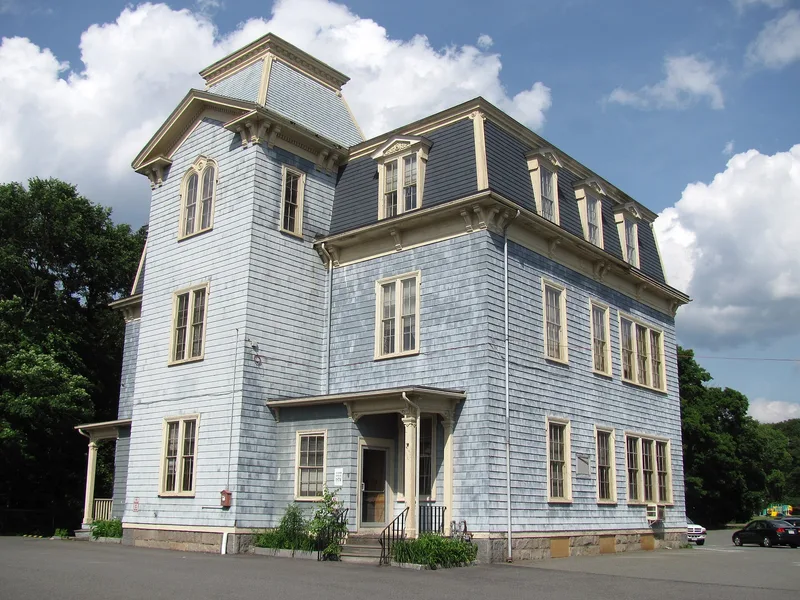
Along more than a mile of High Street in Westwood, Massachusetts, a string of houses, schools and civic buildings records the growth of a village once part of Dedham. The district has 41 contributing resources, ranging from the ca. 1710 Kingsbury House to Dutch Colonial and Bungalow houses of 1927. Most are modest two-and-a-half-story dwellings with center entrances or Greek Revival gable fronts, many with attached barns. Institutional landmarks include the 1847 Greek Revival Village School, the 1874 Colburn School with its mansard roof and tower, and the 1910 Classical Revival Town Hall. Elaborate Queen Anne and Shingle Style houses built by the Fisher and French families stand among older farmhouses. One house, the Timothy Smith House, contains murals by itinerant painter Rufus Porter from 1835. The area is tied to families of farmers, merchants, wood dealers and craftsmen, and it may hold archaeological remains of earlier taverns, shops and houses.
Machine-generated summary. This summary was generated by a language model from the official nomination document and has not been reviewed line by line by an editor. It may contain errors. Check the source document before relying on any detail. Source: nomination document (PDF) · catalog entry. Generated October 2026 (model claude-sonnet-5-5, prompt v1.0-2026-10-29).
| Period of significance | ca. 1710-1927 |
|---|---|
| Styles | Federal, Greek Revival, Italianate, Queen Anne, Colonial Revival, Classical Revival |
| Areas of significance | Architecture, Community Planning and Development |
| Acreage | 40.5 |
| Boundary source | NPS cultural-resource GIS polygon |
| Full listing page | Colburn School-High Street Historic District (property record) |
What listing means for this property
This is a historic district. Buildings within its boundary are either contributing (they add to the district's significance) or non-contributing. Owners of contributing income-producing buildings can claim the 20% federal rehabilitation tax credit; homeowners should look at state credits. National Register districts impose no design review by themselves; a local historic district ordinance, if one exists, does (the difference explained).
General information, not legal or tax advice. Rules change; confirm with your State Historic Preservation Office or a qualified adviser.