Church Street Historic District

Why it's listed
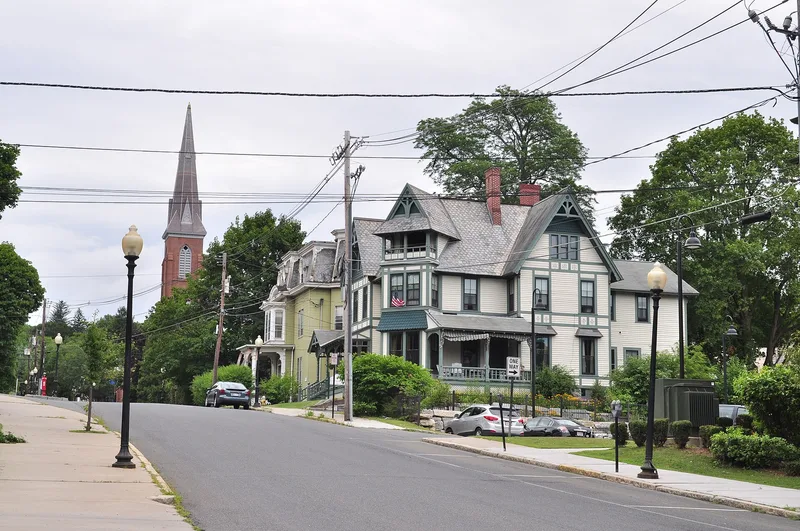
Church Street and East Main Street in North Adams form a V-shaped neighborhood of 56 properties, most of them substantial 19th-century houses. Only four were built after 1900, so the area keeps a largely intact look from the era when the city grew from a rural town into an industrial and railroad center. The houses show a full run of styles, from Federal and Greek Revival to Italianate, Second Empire, Queen Anne, Stick, Shingle and even an early Prairie-style design. Architects represented include Marcus Fayette Cummings, Rufus Russell and Henry Neil Wilson. Much of the building followed the Civil War, when leading mill owners and businessmen moved their homes away from the mill neighborhoods and adopted fashionable styles seen in Albany, Troy and Boston. Two churches, including the landmark Notre Dame Church, and a former parochial school add to the group. Recent restorations and condominium conversions have supported preservation of the district.
Machine-generated summary. This summary was generated by a language model from the official nomination document and has not been reviewed line by line by an editor. It may contain errors. Check the source document before relying on any detail. Source: nomination document (PDF) · catalog entry. Generated October 2026 (model claude-sonnet-5-5, prompt v1.0-2026-10-29).
| Period of significance | 1825-1973 |
|---|---|
| Styles | Range of 19th-century residential styles including Federal, Greek Revival, Italianate, Second Empire, Queen Anne, Stick, Shingle, Eastlake, Gothic Revival, Colonial Revival and Prairie |
| Areas of significance | Industry, Community Planning and Development, Commerce, Architecture |
| Acreage | 19.6 |
| Boundary source | NPS cultural-resource GIS polygon |
| Full listing page | Church Street Historic District (property record) |
What listing means for this property
This is a historic district. Buildings within its boundary are either contributing (they add to the district's significance) or non-contributing. Owners of contributing income-producing buildings can claim the 20% federal rehabilitation tax credit; homeowners should look at state credits. National Register districts impose no design review by themselves; a local historic district ordinance, if one exists, does (the difference explained).
General information, not legal or tax advice. Rules change; confirm with your State Historic Preservation Office or a qualified adviser.