Charles Street Workers' Housing Historic District

The National Park Service has not published a boundary polygon for this district; the map shows the listed properties inside it and the district's reference point.
Why it's listed
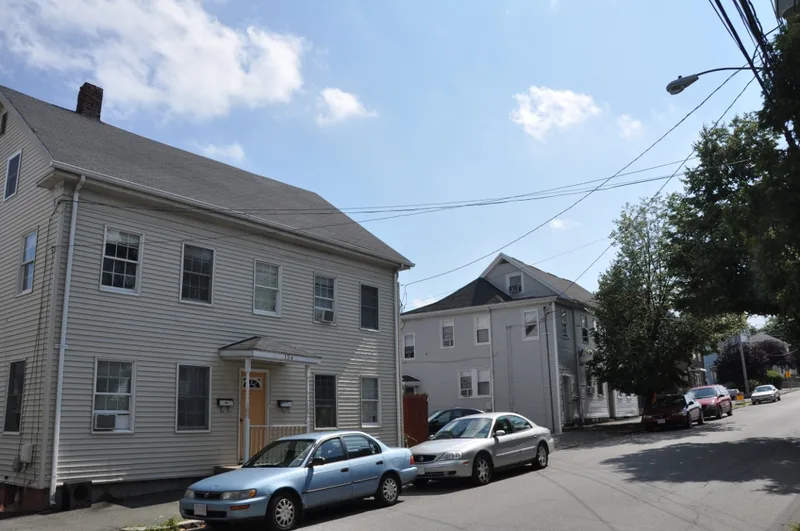
Four modest houses along Charles Street in Waltham, between Williams and Harvard Streets, form a compact district of workers' housing built around 1865. Each rises two and a half stories to a gable roof with twin stove chimneys and is clad in wood shingles. Most carry wide fascias that recall Greek Revival friezes. One is a double house with an eight-bay facade and two hip-roof porches; the others are single-family houses, one with a recessed entry and one altered with a new porch and replacement sash. The land was bought in 1864 by Edward Campbell, a laborer, and the houses were built the following year to serve workers at nearby industries. Patrick Noonan, also listed as a laborer, owned one of them. The surrounding area developed as an Irish enclave, reflected in street names such as Noonan Street and Duddy Avenue. The district was listed for its link to Waltham's industrial growth and for its well-preserved vernacular architecture.
Machine-generated summary. This summary was generated by a language model from the official nomination document and has not been reviewed line by line by an editor. It may contain errors. Check the source document before relying on any detail. Source: nomination document (PDF) · catalog entry. Generated October 2026 (model claude-sonnet-5-5, prompt v1.0-2026-10-29).
| Styles | Vernacular |
|---|---|
| Areas of significance | Industry, Community Planning and Development, Architecture |
| Acreage | 0.6 |
| Boundary source | not published |
| Full listing page | Charles Street Workers' Housing Historic District (property record) |
What listing means for this property
This is a historic district. Buildings within its boundary are either contributing (they add to the district's significance) or non-contributing. Owners of contributing income-producing buildings can claim the 20% federal rehabilitation tax credit; homeowners should look at state credits. National Register districts impose no design review by themselves; a local historic district ordinance, if one exists, does (the difference explained).
General information, not legal or tax advice. Rules change; confirm with your State Historic Preservation Office or a qualified adviser.