Blue Hills Parkway

Why it's listed
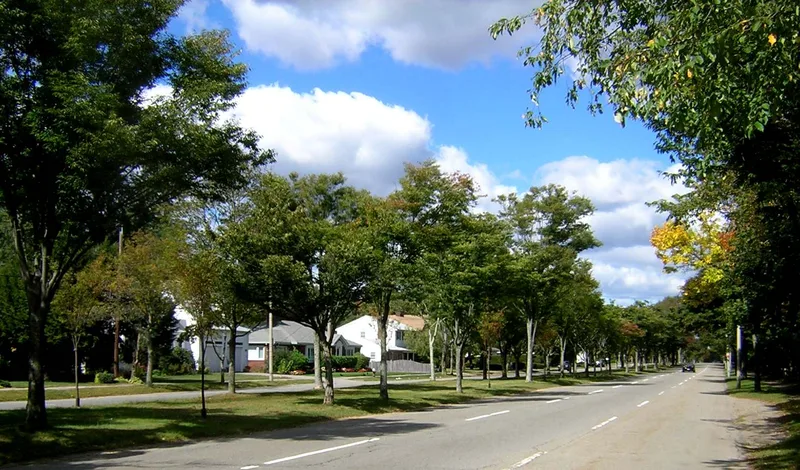
Blue Hills Parkway is a 1.5-mile divided boulevard that begins at Mattapan Square in Boston and runs almost straight south through Milton to Canton Avenue, where the Blue Hills Reservation begins. Planned in the 1890s for the Metropolitan Parks Commission and designed by Olmsted, Olmsted and Eliot and later Olmsted Brothers, it was meant as an approach to the reservation. Charles Eliot's plan called for a 120-foot right of way and one travel lane wider than the other, originally for pleasure carriages. Wide planted medians and tree-lined edges still reflect that design. The granite-faced, triple-arched Mattapan Bridge, built 1901-1903 to a design by Edmund M. Wheelwright, serves as the formal entry over the Neponset River. Other contributing features include a 1823 mile marker, a veterans memorial monument and median islands. The parkway encouraged residential growth in Milton, and its improvements in the 1930s included repaving and added sidewalks.
Machine-generated summary. This summary was generated by a language model from the official nomination document and has not been reviewed line by line by an editor. It may contain errors. Check the source document before relying on any detail. Source: nomination document (PDF) · catalog entry. Generated October 2026 (model claude-sonnet-5-5, prompt v1.0-2026-10-29).
| Period of significance | 1893-1939 |
|---|---|
| Areas of significance | Community Planning and Development, Engineering, Landscape Architecture, Transportation |
| Acreage | 12 |
| Boundary source | NPS cultural-resource GIS polygon |
| Full listing page | Blue Hills Parkway (property record) |
What listing means for this property
This is a historic district. Buildings within its boundary are either contributing (they add to the district's significance) or non-contributing. Owners of contributing income-producing buildings can claim the 20% federal rehabilitation tax credit; homeowners should look at state credits. National Register districts impose no design review by themselves; a local historic district ordinance, if one exists, does (the difference explained).
General information, not legal or tax advice. Rules change; confirm with your State Historic Preservation Office or a qualified adviser.