Blackstone Block Historic District

The National Park Service has not published a boundary polygon for this district; the map shows the listed properties inside it and the district's reference point.
Why it's listed
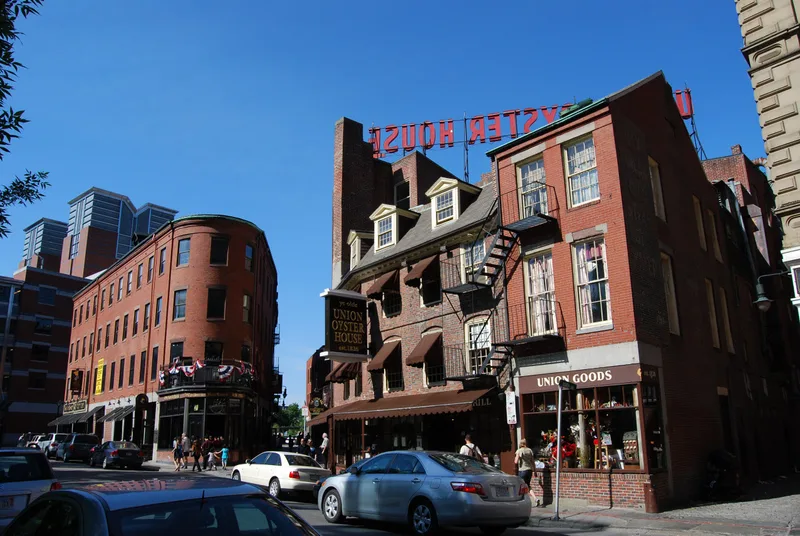
Blackstone Block is a 2.3-acre section of Boston bounded by Union, Hanover, Blackstone and North Streets, just north of the Faneuil Hall and Quincy Market area. It began as a waterfront and mill district beside the Town Cove. Narrow interior alleys, including five-foot-wide Scott Alley, preserve the 17th-century street pattern, and six such lanes survive here. Brick buildings from the 1710s through the 1920s line the lanes and streets, and many are oddly shaped to match old lot lines. Two 18th-century buildings have Revolutionary War links: the Union Oyster House, where Isaiah Thomas printed the Massachusetts Spy from 1771 to 1775, and the Ebenezer Hancock House, where silver crowns from a French loan were brought in 1778. The block also holds the Boston Stone, an old pigment mill whose slab served as a distance marker from 1737. Many buildings have been altered, reduced in height or fitted with modern storefronts.
Machine-generated summary. This summary was generated by a language model from the official nomination document and has not been reviewed line by line by an editor. It may contain errors. Check the source document before relying on any detail. Source: nomination document (PDF) · catalog entry. Generated October 2026 (model claude-sonnet-5-5, prompt v1.0-2026-10-29).
| Styles | Georgian, Federal, Greek Revival, Italianate and French mansard, and early 20th-century commercial buildings |
|---|---|
| Areas of significance | Community Planning and Development, Commerce, Architecture |
| Acreage | 2.3 |
| Boundary source | not published |
| Full listing page | Blackstone Block Historic District (property record) |
What listing means for this property
This is a historic district. Buildings within its boundary are either contributing (they add to the district's significance) or non-contributing. Owners of contributing income-producing buildings can claim the 20% federal rehabilitation tax credit; homeowners should look at state credits. National Register districts impose no design review by themselves; a local historic district ordinance, if one exists, does (the difference explained).
General information, not legal or tax advice. Rules change; confirm with your State Historic Preservation Office or a qualified adviser.