Beach-Knapp District

The National Park Service has not published a boundary polygon for this district; the map shows the listed properties inside it and the district's reference point.
Why it's listed
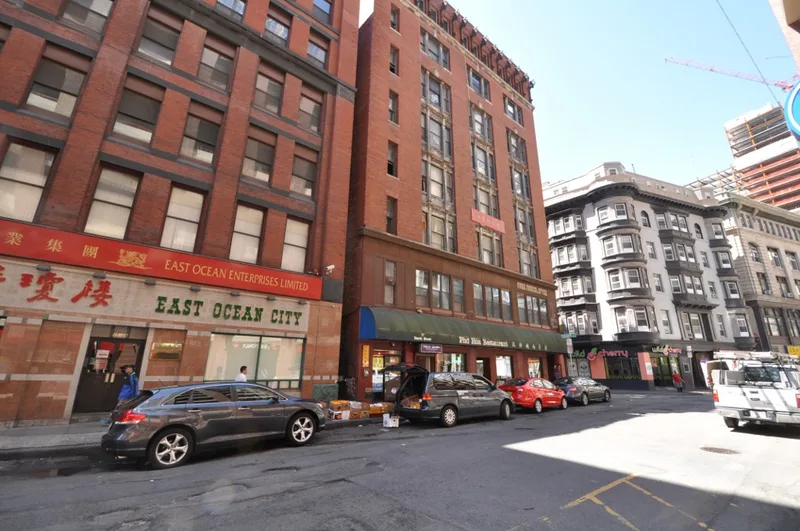
Six buildings on Beach and Knapp Streets, just off lower Washington Street in Boston, make up a compact district that traces the neighborhood's shift from housing to commerce. Two modest brick Greek Revival rowhouses at 5 and 7 Knapp Street, built around 1835, recall the residential era of the 1830s and 1840s. Nearby railroad terminals brought hotels, and the Shakespearian Inn at 7-15 Beach Street, remodelled in 1897, survives with three four-story metal oriel windows, cast iron capitals and a cast iron plaque of William Shakespeare. After the Great Fire of 1872 pushed wholesale and light industrial businesses out of the city center, loft buildings rose here for light manufacturing, especially clothing-related trades. The lofts at 17-23 Beach Street and 9-23 Knapp Street were designed by Shepley, Rutan and Coolidge, and the Knapp Street building shows Richardsonian influence in its simple massing and multistory arcades. Together the buildings are valued as fine examples of their types.
Machine-generated summary. This summary was generated by a language model from the official nomination document and has not been reviewed line by line by an editor. It may contain errors. Check the source document before relying on any detail. Source: nomination document (PDF) · catalog entry. Generated October 2026 (model claude-sonnet-5-5, prompt v1.0-2026-10-29).
| Styles | Victorian Commercial Style, with Renaissance Revival, Romanesque Revival and Greek Revival buildings |
|---|---|
| Areas of significance | Architecture, Performing Arts |
| Acreage | 0.4 |
| Boundary source | not published |
| Full listing page | Beach-Knapp District (property record) |
What listing means for this property
This is a historic district. Buildings within its boundary are either contributing (they add to the district's significance) or non-contributing. Owners of contributing income-producing buildings can claim the 20% federal rehabilitation tax credit; homeowners should look at state credits. National Register districts impose no design review by themselves; a local historic district ordinance, if one exists, does (the difference explained).
General information, not legal or tax advice. Rules change; confirm with your State Historic Preservation Office or a qualified adviser.