Arlington Center Historic District

Why it's listed
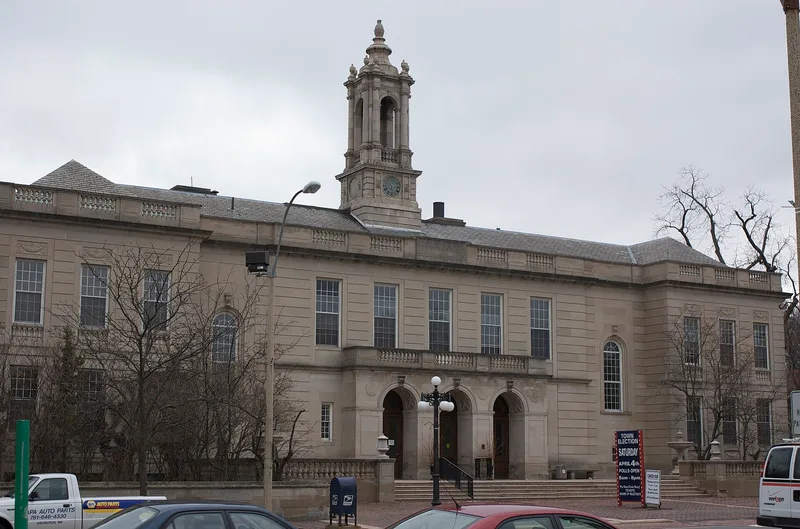
Arlington's town center is a one-block district where Massachusetts Avenue meets Pleasant Street, holding the town's main civic, religious and educational buildings along with a landscaped memorial garden and an old burial ground. Its structures include the Federal-style Whittemore-Robbins House from about 1800, the sandstone Robbins Library of 1892, the Robbins Memorial Town Hall of 1913 and the 1894 Central Junior High School. The First Parish Unitarian Church of 1857, designed by Richard Bond, stood at the corner until it was destroyed by fire in 1975. The site has served as a religious and civic focus since the 1730s, when the first meetinghouse was built near a junction of several early roads. The district was listed because it traces the town's growth, includes notable architecture, and shows how buildings of different uses and styles can share a consistent scale. The garden contains sculptures by Cyrus Dallin.
Machine-generated summary. This summary was generated by a language model from the official nomination document and has not been reviewed line by line by an editor. It may contain errors. Check the source document before relying on any detail. Source: nomination document (PDF) · catalog entry. Generated October 2026 (model claude-sonnet-5-5, prompt v1.0-2026-10-29).
| Styles | Mixed: Federal, Romanesque Revival, Second Renaissance Revival, Classical Revival, Italianate |
|---|---|
| Areas of significance | Landscape Architecture, Art, Architecture |
| Acreage | 13 |
| Boundary source | NPS cultural-resource GIS polygon |
| Full listing page | Arlington Center Historic District (property record) |
What listing means for this property
This is a historic district. Buildings within its boundary are either contributing (they add to the district's significance) or non-contributing. Owners of contributing income-producing buildings can claim the 20% federal rehabilitation tax credit; homeowners should look at state credits. National Register districts impose no design review by themselves; a local historic district ordinance, if one exists, does (the difference explained).
General information, not legal or tax advice. Rules change; confirm with your State Historic Preservation Office or a qualified adviser.