Anderson, Larz, Park Historic District

Why it's listed
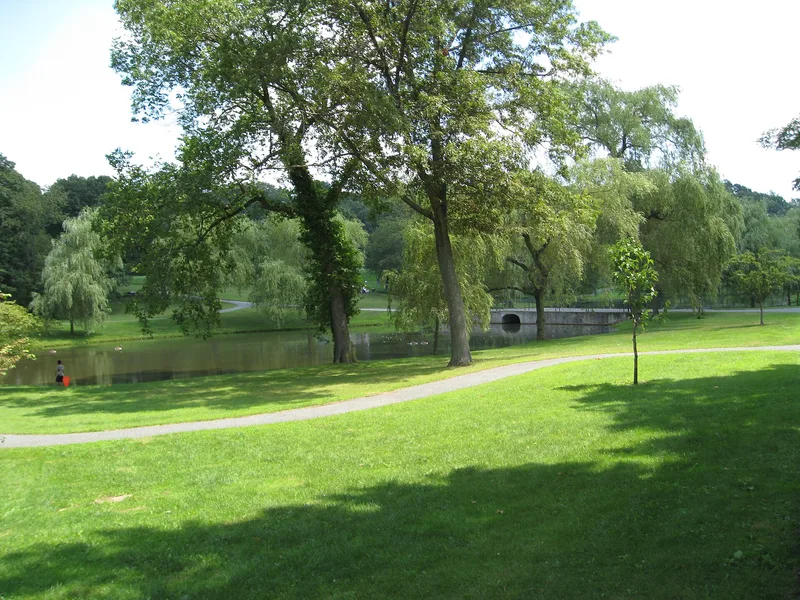
Larz Anderson Park in Brookline covers almost 62 acres of town-owned land that once formed the Weld estate, called "Windy Top" and later "Weld." The land was earlier the Goddard family's property. After Isabel Perkins Anderson acquired the estate in 1899, the grounds were landscaped to plans by Charles Platt. Her husband Larz Anderson served as a United States ambassador, and the couple entertained political and social figures here. The estate passed to the Town after her death in 1948, with a requirement that it serve educational and recreational purposes. Surviving features include a lagoon, a tree allee, a gazebo and remnants of an Italian garden. Buildings include the Wheelwright-designed carriage house, now a transportation museum, a stucco gatehouse, the Putterham School dating from the 1760s, a late 18th-century cottage and an Italianate house of the mid 19th century. Later skating and service buildings are noncontributing.
Machine-generated summary. This summary was generated by a language model from the official nomination document and has not been reviewed line by line by an editor. It may contain errors. Check the source document before relying on any detail. Source: nomination document (PDF) · catalog entry. Generated October 2026 (model claude-sonnet-5-5, prompt v1.0-2026-10-29).
| Styles | Variety of architectural styles, including an Italianate house and a carriage house said to be modelled on the Chateau de Chaumont |
|---|---|
| Areas of significance | Landscape Architecture, Exploration/Settlement |
| Acreage | 62 |
| Boundary source | NPS cultural-resource GIS polygon |
| Full listing page | Anderson, Larz, Park Historic District (property record) |
What listing means for this property
This is a historic district. Buildings within its boundary are either contributing (they add to the district's significance) or non-contributing. Owners of contributing income-producing buildings can claim the 20% federal rehabilitation tax credit; homeowners should look at state credits. National Register districts impose no design review by themselves; a local historic district ordinance, if one exists, does (the difference explained).
General information, not legal or tax advice. Rules change; confirm with your State Historic Preservation Office or a qualified adviser.