Amesbury and Salisbury Mills Village Historic District

Why it's listed
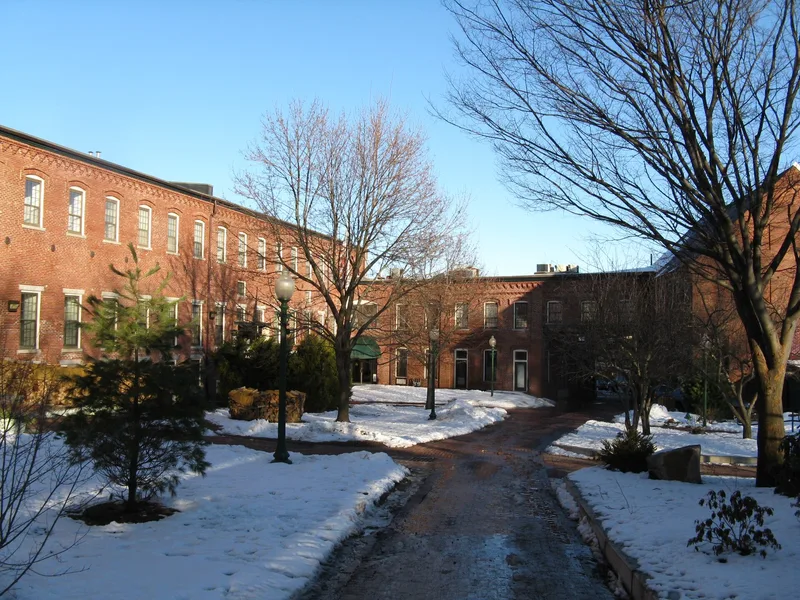
Amesbury's historic core is a compact, 15-acre industrial and commercial district centered on Market Square and the Powow River, which drops 75 feet in a series of waterfalls just north of the square. Of 76 buildings, 60 contribute to its character. Nine red-brick textile mills, seven of them forming the Millyard, date from 1825 to 1875; the earliest was built over a millrace, and an 1872 mill was the first in town powered by steam. Around the square stand brick commercial blocks in Italianate and Renaissance Revival styles, a Neoclassical post office of 1905 designed by James Knox Taylor, a Baptist church of 1873, and houses from the Federal, Greek Revival and mansard periods. The consistent height, scale and brick construction give the area a unified appearance. The textile industry ended in 1912, and many mills are now vacant or in small-scale industrial use. The area also holds high potential for historic archaeological remains.
Machine-generated summary. This summary was generated by a language model from the official nomination document and has not been reviewed line by line by an editor. It may contain errors. Check the source document before relying on any detail. Source: nomination document (PDF) · catalog entry. Generated October 2026 (model claude-sonnet-5-5, prompt v1.0-2026-10-29).
| Styles | Greek Revival, Italianate, Renaissance Revival, Neoclassical (19th-century mill and commercial architecture) |
|---|---|
| Areas of significance | Industry, Community Planning and Development, Commerce, Architecture, Invention |
| Acreage | 15 |
| Boundary source | NPS cultural-resource GIS polygon |
| Full listing page | Amesbury and Salisbury Mills Village Historic District (property record) |
What listing means for this property
This is a historic district. Buildings within its boundary are either contributing (they add to the district's significance) or non-contributing. Owners of contributing income-producing buildings can claim the 20% federal rehabilitation tax credit; homeowners should look at state credits. National Register districts impose no design review by themselves; a local historic district ordinance, if one exists, does (the difference explained).
General information, not legal or tax advice. Rules change; confirm with your State Historic Preservation Office or a qualified adviser.