American Woolen Mill Housing District

Why it's listed
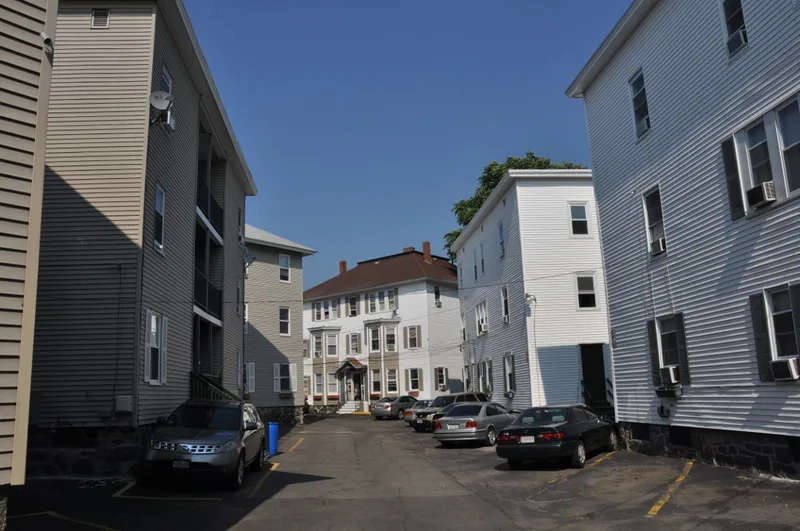
Nine wood-frame tenements on Market Street in South Lawrence make up this housing group, completed in 1909 for the American Woolen Company and designed by local architect James E. Allen. The three-story buildings are arranged symmetrically, each half mirroring the other, yet five different designs and angled placement give variety. Queen Anne and Colonial Revival details include pedimented entries, fluted pilasters, bay windows, twenty-five-pane upper sash, and bands of patterned shingles. The layout gave residents more light and air while keeping lot density high, and lawns, trees, shrubs and iron fencing once framed an inner court. The complex provided homes for the families of 36 company employees as part of a 1906-1910 expansion that added 142 residential units in South Lawrence. It is significant as an example of corporate paternalism and as a cohesive planned group. Allen later designed many homes in Shawsheen Village. These tenements remain the best preserved of the company's earlier housing.
Machine-generated summary. This summary was generated by a language model from the official nomination document and has not been reviewed line by line by an editor. It may contain errors. Check the source document before relying on any detail. Source: nomination document (PDF) · catalog entry. Generated October 2026 (model claude-sonnet-5-5, prompt v1.0-2026-10-29).
| Period of significance | 1900- |
|---|---|
| Styles | Queen Anne and Colonial Revival motifs |
| Areas of significance | Industry, Community Planning and Development, Social History |
| Acreage | 0.8 |
| Boundary source | NPS cultural-resource GIS polygon |
| Full listing page | American Woolen Mill Housing District (property record) |
What listing means for this property
This is a historic district. Buildings within its boundary are either contributing (they add to the district's significance) or non-contributing. Owners of contributing income-producing buildings can claim the 20% federal rehabilitation tax credit; homeowners should look at state credits. National Register districts impose no design review by themselves; a local historic district ordinance, if one exists, does (the difference explained).
General information, not legal or tax advice. Rules change; confirm with your State Historic Preservation Office or a qualified adviser.