Adams National Historic Site

The National Park Service has not published a boundary polygon for this district; the map shows the listed properties inside it and the district's reference point.
Why it's listed
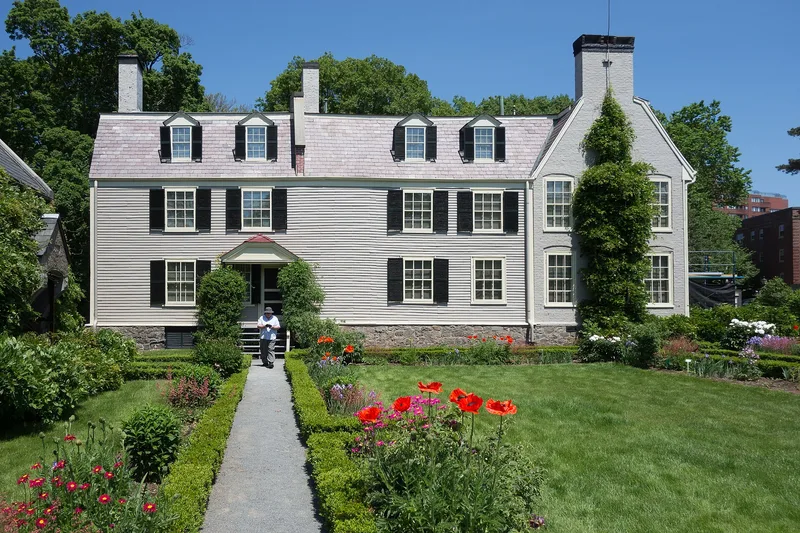
Adams National Historic Site occupies 8.45 acres in Quincy, Massachusetts, and preserves the long-term home of four generations of the Adams family. At its center is the Old House, begun in 1731 as a Georgian country villa and enlarged by John Adams, John Quincy Adams and Charles Francis Adams. Other surviving structures include a stone library built in 1870 that holds about 14,000 volumes, a Victorian carriage house completed in 1873, a greenhouse, and a woodshed. An eighteenth-century formal garden, an orchard and a duck pond complete the grounds. The adjoining Beale estate, with a Federal-style house built in 1792, was added in 1972. The site matters because the Adamses lived here from 1788 to 1927 while serving as presidents, diplomats and writers. The house and its furnishings remain as the family left them, showing the changing tastes of each generation rather than a single period.
Machine-generated summary. This summary was generated by a language model from the official nomination document and has not been reviewed line by line by an editor. It may contain errors. Check the source document before relying on any detail. Source: nomination document (PDF) · catalog entry. Generated October 2026 (model claude-sonnet-5-5, prompt v1.0-2026-10-29).
| Period of significance | 1788-1927 |
|---|---|
| Styles | Georgian (Old House); Victorian eclectic (Library, Carriage House); Federal (Beale House) |
| Areas of significance | Landscape Architecture, Literature, Politics/Government, Architecture |
| Acreage | 8.5 |
| Boundary source | not published |
| Full listing page | Adams National Historic Site (property record) |
What listing means for this property
This is a historic district. Buildings within its boundary are either contributing (they add to the district's significance) or non-contributing. Owners of contributing income-producing buildings can claim the 20% federal rehabilitation tax credit; homeowners should look at state credits. National Register districts impose no design review by themselves; a local historic district ordinance, if one exists, does (the difference explained).
General information, not legal or tax advice. Rules change; confirm with your State Historic Preservation Office or a qualified adviser.