Yakel House and Union Brewery

The National Park Service has not published a boundary polygon for this district; the map shows the listed properties inside it and the district's reference point.
Why it's listed
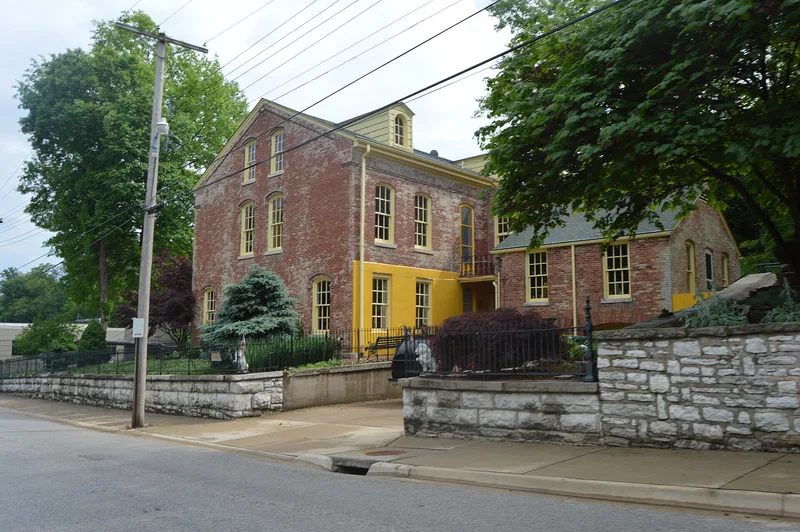
On a triangular 4.8-acre site in Alton, Illinois, a brick house and a cluster of brewery buildings record more than a century of German-American enterprise. Philip Yakel arrived from Germany in 1836 and founded Alton's first brewery, the Union Brewery. His son George built the two-and-a-half-story brick house in 1863, with a center hall, high second-floor ceilings and an ornamented iron balcony. In 1882 William Netzhammer, a brewmaster from Baden, Germany, bought the property and renamed the business Bluff City Brewery. Beer was made until wartime restrictions in 1918, and during Prohibition the brewery was licensed to produce near-beer. Brewing resumed in 1933 and stopped in 1952 when refrigeration machinery failed. The thirteen buildings include early stone structures from the 1830s and 1840s, a prominent 1860s brick packing-washroom building, and 1930s warehouse and office buildings. Only two families owned the property, and its hillside setting keeps the look of a separate enclave.
Machine-generated summary. This summary was generated by a language model from the official nomination document and has not been reviewed line by line by an editor. It may contain errors. Check the source document before relying on any detail. Source: nomination document (PDF) · catalog entry. Generated October 2026 (model claude-sonnet-5-5, prompt v1.0-2026-10-29).
| Period of significance | 1800-1899 (house 1863; brewery from 1836) |
|---|---|
| Styles | Vernacular brick construction with German antecedents (house); industrial brewery buildings |
| Areas of significance | Industry, Architecture |
| Acreage | 4.8 |
| Boundary source | not published |
| Full listing page | Yakel House and Union Brewery (property record) |
What listing means for this property
This is a historic district. Buildings within its boundary are either contributing (they add to the district's significance) or non-contributing. Owners of contributing income-producing buildings can claim the 20% federal rehabilitation tax credit; homeowners should look at state credits. National Register districts impose no design review by themselves; a local historic district ordinance, if one exists, does (the difference explained).
General information, not legal or tax advice. Rules change; confirm with your State Historic Preservation Office or a qualified adviser.