Wicker Park Historic District

Why it's listed
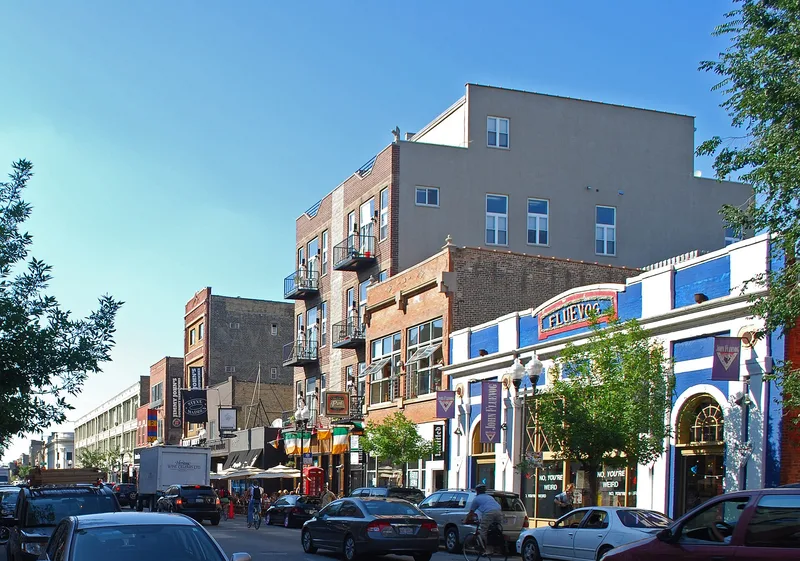
Wicker Park is an inner-city Chicago neighborhood about three miles northwest of the downtown business district, centered just west of Milwaukee Avenue. Its flat, tree-lined streets hold roughly 853 structures, mostly masonry buildings dating from the late nineteenth century. Most show Italianate or Queen Anne influence, often blended rather than pure, with some later revival styles. The housing mix is unusually wide, ranging from row houses and modest two-flats to large single-family mansions with yards on streets such as Hoyne, Caton and Pierce. Milwaukee Avenue forms a nearly continuous three-story commercial wall, and a small skyscraper marks the six-corners intersection of Damen, North and Milwaukee. The district was drawn around Charles Wicker's subdivision and nearby land still unplatted in 1869. The nomination stresses the value of the unbroken streetscape, where even plain background buildings link the more notable ones. It also warns that demolition, siding and public housing intrusions threaten that continuity.
Machine-generated summary. This summary was generated by a language model from the official nomination document and has not been reviewed line by line by an editor. It may contain errors. Check the source document before relying on any detail. Source: nomination document (PDF) · catalog entry. Generated October 2026 (model claude-sonnet-5-5, prompt v1.0-2026-10-29).
| Styles | Predominantly Italianate and Queen Anne, with a scattering of revival styles after about 1890 |
|---|---|
| Areas of significance | Architecture |
| Acreage | 166 |
| Boundary source | NPS cultural-resource GIS polygon |
| Full listing page | Wicker Park Historic District (property record) |
What listing means for this property
This is a historic district. Buildings within its boundary are either contributing (they add to the district's significance) or non-contributing. Owners of contributing income-producing buildings can claim the 20% federal rehabilitation tax credit; homeowners should look at state credits. National Register districts impose no design review by themselves; a local historic district ordinance, if one exists, does (the difference explained).
General information, not legal or tax advice. Rules change; confirm with your State Historic Preservation Office or a qualified adviser.