Washington Park Historic District

Why it's listed
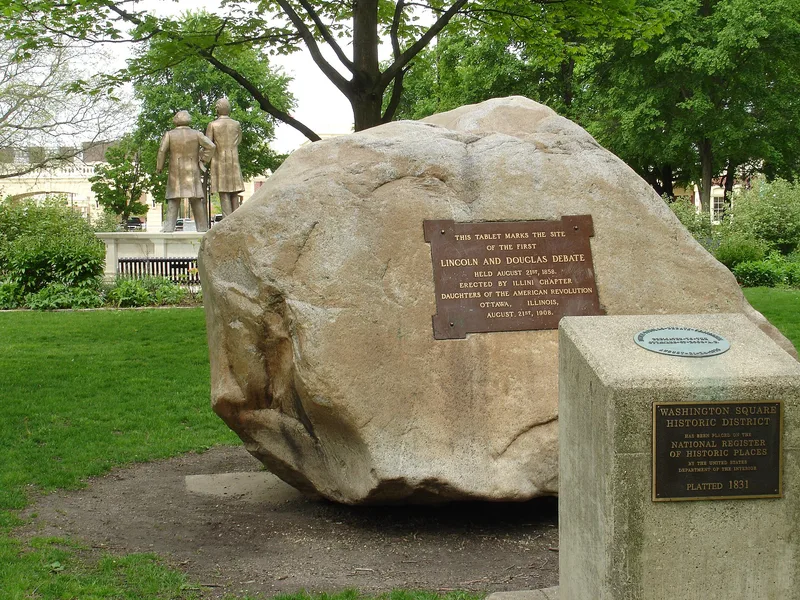
Washington Park, also known as Washington Square, is a one-block landscaped park in downtown Ottawa, Illinois, laid out in 1831 when the Illinois-Michigan Canal Commission planned the town's addition. Historic buildings surround it: Reddick's Library and the Appellate Court, both begun in 1857, two churches on the east side dating from 1870 and 1871, and the former county jail, converted from a residence of about 1880. Inside the park are a lit boulder marking the first Lincoln-Douglas debate, a Civil War memorial column dedicated in 1873, cannons, gas lights honoring W. D. Boyce, a fountain and an 1890s popcorn wagon. The debate took place here on August 21, 1858, before a large crowd drawn by wagon, trail and canal, and addressed popular sovereignty and slavery. The square was listed because of this event and because it has served as a focus of Ottawa's civic life from the 1850s into the twentieth century.
Machine-generated summary. This summary was generated by a language model from the official nomination document and has not been reviewed line by line by an editor. It may contain errors. Check the source document before relying on any detail. Source: nomination document (PDF) · catalog entry. Generated October 2026 (model claude-sonnet-5-5, prompt v1.0-2026-10-29).
| Period of significance | 19th Century |
|---|---|
| Styles | Italianate (Reddick House/Library) |
| Areas of significance | Politics/Government, Architecture, Religion |
| Acreage | 12.8 |
| Boundary source | NPS cultural-resource GIS polygon |
| Full listing page | Washington Park Historic District (property record) |
What listing means for this property
This is a historic district. Buildings within its boundary are either contributing (they add to the district's significance) or non-contributing. Owners of contributing income-producing buildings can claim the 20% federal rehabilitation tax credit; homeowners should look at state credits. National Register districts impose no design review by themselves; a local historic district ordinance, if one exists, does (the difference explained).
General information, not legal or tax advice. Rules change; confirm with your State Historic Preservation Office or a qualified adviser.