Washington Park

Why it's listed
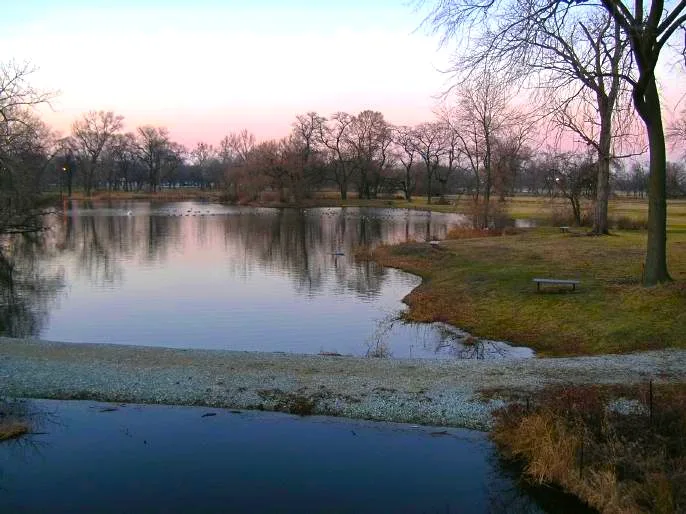
Washington Park is a 367-acre public park on Chicago's South Side, bounded by 51st Street, 60th Street, Cottage Grove Avenue and King Drive. It began in 1871 as the Western Division of South Park, designed by Frederick Law Olmsted and Calvert Vaux, and was named in 1881. Its figure-eight circuit drives, the Mere lagoon, the Pool, the tree-lined Mall, the Seven Hills landscape and the South Open Green still follow the original design closely. Historic structures include the 1880 Stables/Roundhouse by Burnham & Root, the oldest building in the park, a 1904 brick comfort station, two bridges to Bynum Island and Lorado Taft's 1922 Fountain of Time. The park is recognized because Jackson Park was reshaped for the 1893 World's Columbian Exposition and the Midway Plaisance was never completed as planned, leaving Washington Park as the best-preserved example of Olmsted's South Park concept. It sits at the south end of the Bronzeville community.
Machine-generated summary. This summary was generated by a language model from the official nomination document and has not been reviewed line by line by an editor. It may contain errors. Check the source document before relying on any detail. Source: nomination document (PDF) · catalog entry. Generated October 2026 (model claude-sonnet-5-5, prompt v1.0-2026-10-29).
| Styles | Beaux Arts Classicism; Art Deco |
|---|---|
| Areas of significance | Landscape Architecture, Entertainment/Recreation, Social History, Architecture |
| Acreage | 367 |
| Boundary source | NPS cultural-resource GIS polygon |
| Full listing page | Washington Park (property record) |
What listing means for this property
This is a historic district. Buildings within its boundary are either contributing (they add to the district's significance) or non-contributing. Owners of contributing income-producing buildings can claim the 20% federal rehabilitation tax credit; homeowners should look at state credits. National Register districts impose no design review by themselves; a local historic district ordinance, if one exists, does (the difference explained).
General information, not legal or tax advice. Rules change; confirm with your State Historic Preservation Office or a qualified adviser.