Villa Historic District
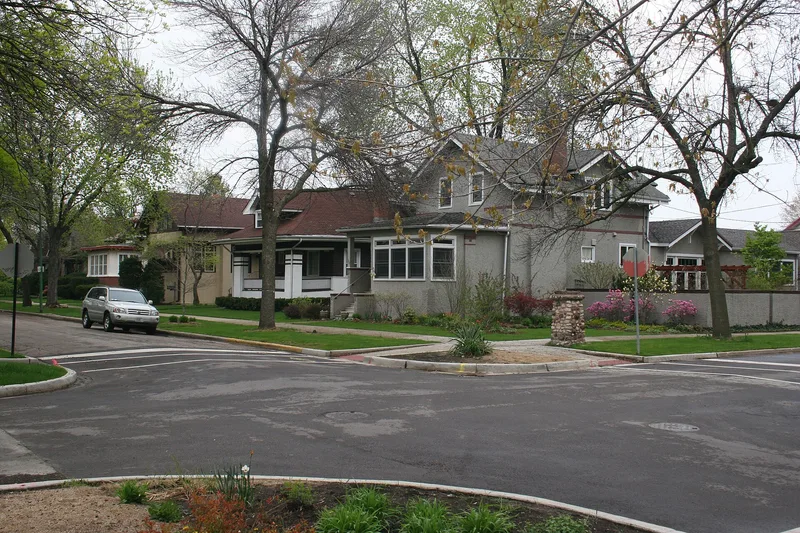

Why it's listed
Villa is a planned residential neighborhood on Chicago's near northwest side, within the older Irving Park community. About 126 single-family houses fill roughly seven blocks, nearly all built between about 1907 and 1925. They are one-and-a-half and two-story brick or frame homes derived from the Chicago bungalow, with Prairie School detailing and some California Bungalow influence. Developer Albert Haentze laid out the wide landscaped boulevards, Harding and Avers, before building began, and set deed covenants requiring single-family homes, lots of at least 50 feet of frontage and a minimum construction cost. His firm, Haentze & Wheeler, built most of the houses. Architect Clarence Hatzfeld is thought to have designed many of them. Stone corner planters added in 1923 and a resident improvement league have helped keep the area's character intact. Only three modern houses are considered out of character. The district is also noted as home to several prominent Chicago figures.
Machine-generated summary. This summary was generated by a language model from the official nomination document and has not been reviewed line by line by an editor. It may contain errors. Check the source document before relying on any detail. Source: nomination document (PDF) · catalog entry. Generated October 2026 (model claude-sonnet-5-5, prompt v1.0-2026-10-29).
| Period of significance | c.1907-1925 |
|---|---|
| Styles | "Villa Bungalow" - Chicago Bungalow derivative with Prairie School and California Bungalow influences |
| Areas of significance | Community Planning and Development, Architecture |
| Acreage | 26.8 |
| Boundary source | NPS cultural-resource GIS polygon |
| Full listing page | Villa Historic District (property record) |
What listing means for this property
This is a historic district. Buildings within its boundary are either contributing (they add to the district's significance) or non-contributing. Owners of contributing income-producing buildings can claim the 20% federal rehabilitation tax credit; homeowners should look at state credits. National Register districts impose no design review by themselves; a local historic district ordinance, if one exists, does (the difference explained).
General information, not legal or tax advice. Rules change; confirm with your State Historic Preservation Office or a qualified adviser.