South Dearborn Street-Printing House Row Historic District

The National Park Service has not published a boundary polygon for this district; the map shows the listed properties inside it and the district's reference point.
Why it's listed
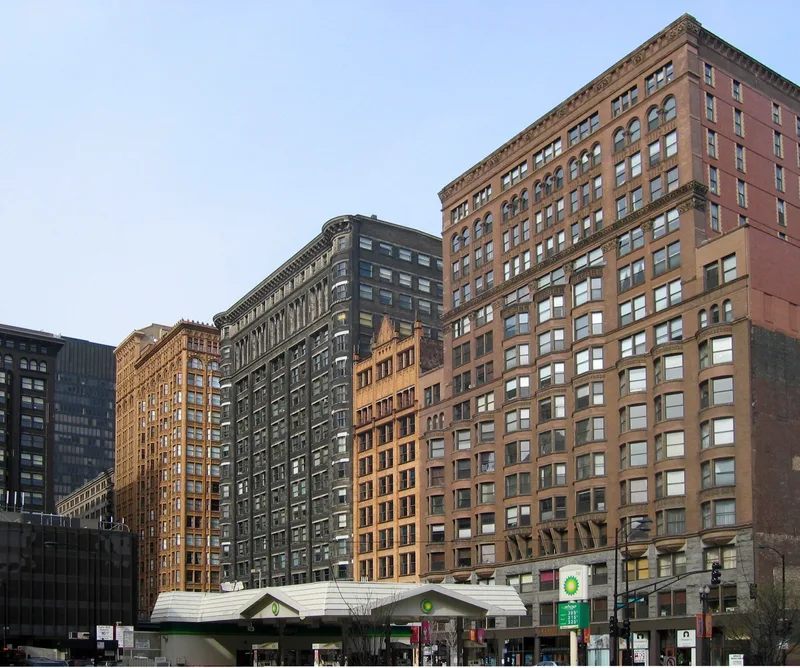
This compact district along South Dearborn Street in Chicago brings together four major commercial buildings of the late 1800s, in an area associated with publishing and printing. The Manhattan Building, designed by William LeBaron Jenney, was the world's tallest when built and was the first to use wind bracing on its skeleton frame. Daniel Burnham's Fisher Building, with Gothic ornament, was one of the first curtain wall structures. The Old Colony Building, by Holabird and Roche, shows construction techniques of its day, and its narrow form suited the printing trades. The Monadnock Building was built in two parts, a north half by Burnham and Root in 1880-1891 and a south half by Holabird and Roche in 1893. It is one of the largest masonry bearing wall structures ever built and is often praised for its unified design. Together the buildings illustrate the Chicago School and the development of the skyscraper.
Machine-generated summary. This summary was generated by a language model from the official nomination document and has not been reviewed line by line by an editor. It may contain errors. Check the source document before relying on any detail. Source: nomination document (PDF) · catalog entry. Generated October 2026 (model claude-sonnet-5-5, prompt v1.0-2026-10-29).
| Period of significance | 1800-1899 |
|---|---|
| Styles | Chicago School; the Manhattan Building is described as Romanesque in style |
| Areas of significance | Architecture |
| Boundary source | not published |
| Full listing page | South Dearborn Street-Printing House Row Historic District (property record) |
What listing means for this property
This is a historic district. Buildings within its boundary are either contributing (they add to the district's significance) or non-contributing. Owners of contributing income-producing buildings can claim the 20% federal rehabilitation tax credit; homeowners should look at state credits. National Register districts impose no design review by themselves; a local historic district ordinance, if one exists, does (the difference explained).
General information, not legal or tax advice. Rules change; confirm with your State Historic Preservation Office or a qualified adviser.