South Charter Street Historic District

Why it's listed
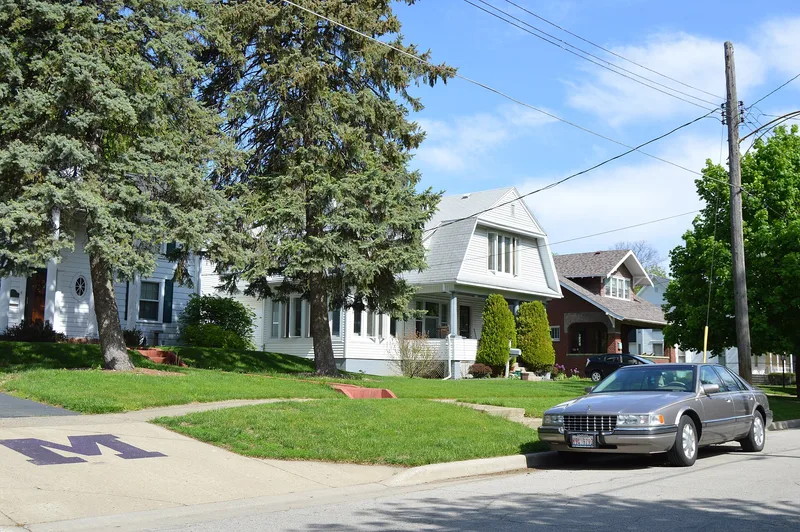
South Charter Street Historic District is a residential neighborhood just south of downtown Monticello, the county seat of Piatt County, Illinois. It stretches from Marion Street to Sage Drive and spans two blocks between South Market and South State Streets. Its roughly 77 resources include houses, carriage barns, garages, a shed, and objects such as limestone carriage posts and a carriage step. Many lots keep their full depth, so outbuildings line the side streets. The district shows no single dominant style. Gothic Revival, Italianate, Queen Anne, Dutch Colonial Revival, Tudor Revival and Georgian Revival houses stand beside vernacular forms such as a five-bay I-House, Gabled Ells and Bungalows. The area matters as the first burst of growth outside Monticello's original 1837 town plat, developed on the Out Lots and Mary J. Piatt's South Addition of 1858. Its buildings date from about 1855 to about 1940, and generous lots and mature landscaping preserve the historic setting.
Machine-generated summary. This summary was generated by a language model from the official nomination document and has not been reviewed line by line by an editor. It may contain errors. Check the source document before relying on any detail. Source: nomination document (PDF) · catalog entry. Generated October 2026 (model claude-sonnet-5-5, prompt v1.0-2026-10-29).
| Period of significance | c. 1855 - c. 1940 |
|---|---|
| Styles | Queen Anne, Dutch Colonial Revival, Gabled Ell, and a mix of other styles and vernacular types (Gothic Revival, Italianate, Classical Revival, Tudor Revival, Georgian Revival, Bungalow, I-House) |
| Areas of significance | Architecture |
| Acreage | 13.5 |
| Boundary source | NPS cultural-resource GIS polygon |
| Full listing page | South Charter Street Historic District (property record) |
What listing means for this property
This is a historic district. Buildings within its boundary are either contributing (they add to the district's significance) or non-contributing. Owners of contributing income-producing buildings can claim the 20% federal rehabilitation tax credit; homeowners should look at state credits. National Register districts impose no design review by themselves; a local historic district ordinance, if one exists, does (the difference explained).
General information, not legal or tax advice. Rules change; confirm with your State Historic Preservation Office or a qualified adviser.