Peoria State Hospital
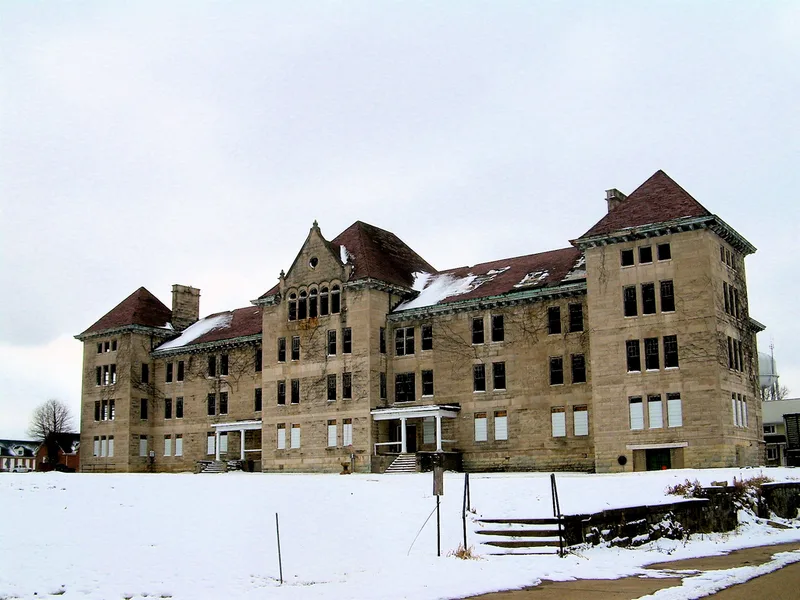

Why it's listed
Peoria State Hospital is a campus of 47 buildings on a wooded plateau at the edge of the Illinois River bluff in Bartonville. Construction began in 1899 with support buildings, and the hospital opened in 1902. It was laid out as a small, partly self-supporting city. Twenty-seven residential cottages form an undulating circle around central administration, shopping and activity buildings, with hospitals, a power plant, laundry, shops and warehouses grouped nearby. Most buildings are brick or stone, and many show Georgian Revival design. The hospital is regarded as a leading example of the cottage plan, which favored small, simple dormitories over the single large fortress-like structure of the earlier Kirkbride model. It is also associated with Dr. George Zeller, credited with removing bars and mechanical restraints from patient rooms. Few buildings have been significantly altered, though a few were remodeled or replaced in the 1960s. The hospital closed in 1973, and the empty buildings have since suffered broken windows, stripped fixtures and interior decay.
Machine-generated summary. This summary was generated by a language model from the official nomination document and has not been reviewed line by line by an editor. It may contain errors. Check the source document before relying on any detail. Source: nomination document (PDF) · catalog entry. Generated October 2026 (model claude-sonnet-5-5, prompt v1.0-2026-10-29).
| Styles | Cottage plan hospital complex with mostly Georgian Revival buildings, plus Prairie, Mission Style, Neo-Classical Revival and Romanesque Revival influences |
|---|---|
| Areas of significance | Architecture, Social History |
| Acreage | 215.5 |
| Boundary source | NPS cultural-resource GIS polygon |
| Full listing page | Peoria State Hospital (property record) |
What listing means for this property
This is a historic district. Buildings within its boundary are either contributing (they add to the district's significance) or non-contributing. Owners of contributing income-producing buildings can claim the 20% federal rehabilitation tax credit; homeowners should look at state credits. National Register districts impose no design review by themselves; a local historic district ordinance, if one exists, does (the difference explained).
Noted as vacant in the nomination. Nomination documents can be decades old; current status may differ. If you are considering buying an empty listed property, read the due-diligence checklist.
General information, not legal or tax advice. Rules change; confirm with your State Historic Preservation Office or a qualified adviser.