Parkway Garden Homes

Why it's listed
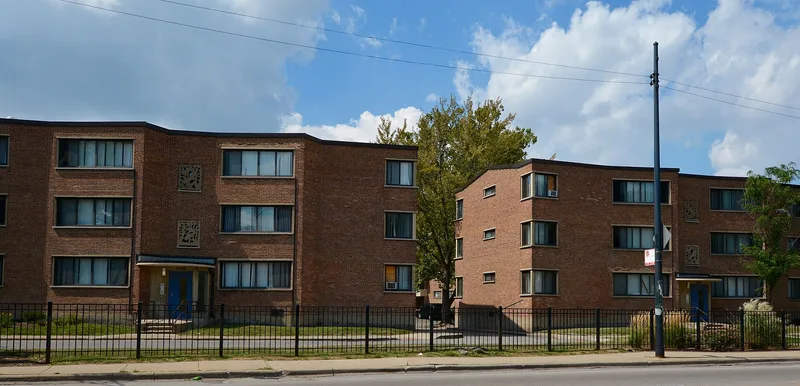
Parkway Garden Homes is a fifteen-acre apartment complex on Chicago's South Side, built between 1950 and 1955 on the site of the former White City Amusement Park. It holds 694 cooperatively owned apartments in eleven eight-story elevator buildings and twenty-four three-story walk-ups, all of reinforced brick, with canted window bays, corner windows and streamlined concrete entrance canopies. The project began in 1945 when officers of the Dining Car Workers Union sought better housing for their members, and it was developed by the Community Development Trust. It was among the country's largest privately financed developments planned for and led by African Americans, and housing and civil rights advocates praised it as a model for affordable urban housing. Architect Henry K. Holsman designed it as his last large housing project, joining low-rise and high-rise forms in one mutual-ownership development. The complex still serves as housing and retains a high degree of integrity.
Machine-generated summary. This summary was generated by a language model from the official nomination document and has not been reviewed line by line by an editor. It may contain errors. Check the source document before relying on any detail. Source: nomination document (PDF) · catalog entry. Generated October 2026 (model claude-sonnet-5-5, prompt v1.0-2026-10-29).
| Period of significance | 1950-1961 |
|---|---|
| Styles | Modern Movement/Moderne |
| Areas of significance | Community Planning and Development, Architecture |
| Acreage | 15 |
| Boundary source | NPS cultural-resource GIS polygon |
| Full listing page | Parkway Garden Homes (property record) |
What listing means for this property
This is a historic district. Buildings within its boundary are either contributing (they add to the district's significance) or non-contributing. Owners of contributing income-producing buildings can claim the 20% federal rehabilitation tax credit; homeowners should look at state credits. National Register districts impose no design review by themselves; a local historic district ordinance, if one exists, does (the difference explained).
General information, not legal or tax advice. Rules change; confirm with your State Historic Preservation Office or a qualified adviser.