Mercer County Fairgrounds

Why it's listed
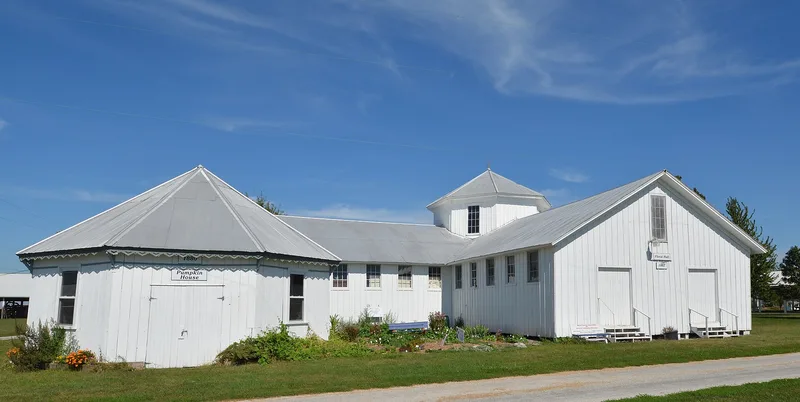
Mercer County Fairgrounds occupies 52.41 flat acres on the southwest side of Aledo, Illinois, where the county fair has been held since the Agricultural Society moved it from Millersburg in 1869. The grounds contain a half-mile dirt track with a grandstand, exhibition halls, animal barns, a brick office and ticket building, and food stands. Eleven buildings contribute to the district. The oldest is the eight-sided Exhibition Building of 1880, known as the Pumpkin Building, followed by the Greek Cross-plan Floral Hall of 1882, built by contractor J. S. Pinkerton. A fire in 1920 destroyed most wooden structures on the south side, and the swine barn and rest rooms were built in 1921 to replace them. The 1926 Merchants' Building was finished in under a month. Fair competitions pushed local farmers to improve yields, and the grounds became a long-running community gathering place. The fair continues there each July, so use of the site has not changed.
Machine-generated summary. This summary was generated by a language model from the official nomination document and has not been reviewed line by line by an editor. It may contain errors. Check the source document before relying on any detail. Source: nomination document (PDF) · catalog entry. Generated October 2026 (model claude-sonnet-5-5, prompt v1.0-2026-10-29).
| Styles | Late Victorian; Late 19th and 20th Century American Movements |
|---|---|
| Areas of significance | Agriculture, Entertainment/Recreation |
| Acreage | 52.4 |
| Boundary source | NPS cultural-resource GIS polygon |
| Full listing page | Mercer County Fairgrounds (property record) |
What listing means for this property
This is a historic district. Buildings within its boundary are either contributing (they add to the district's significance) or non-contributing. Owners of contributing income-producing buildings can claim the 20% federal rehabilitation tax credit; homeowners should look at state credits. National Register districts impose no design review by themselves; a local historic district ordinance, if one exists, does (the difference explained).
General information, not legal or tax advice. Rules change; confirm with your State Historic Preservation Office or a qualified adviser.