Independence Park

Why it's listed
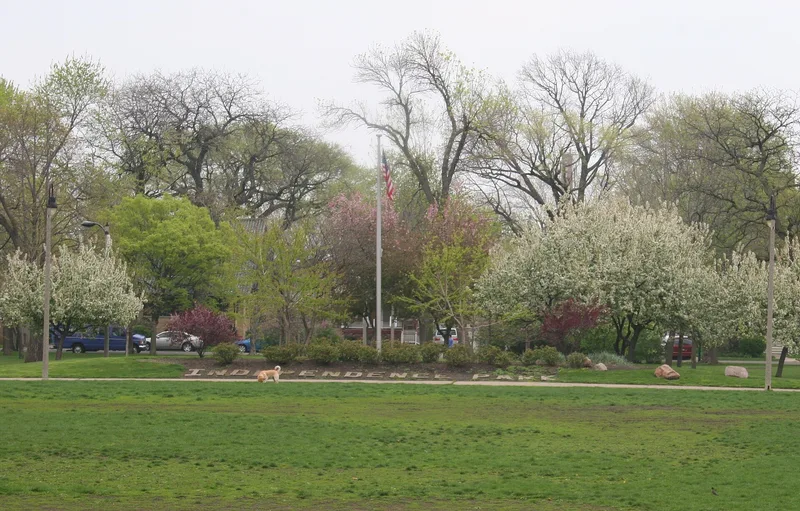
Independence Park is a 7.86-acre public park on Chicago's northwest side, created by the Irving Park District after residents began holding Fourth of July celebrations on the site in 1903. Its centerpiece is a red brick field house completed in 1914 by architects Hatzfeld and Knox. The Classical Revival building has arched openings, a cruciform plan and Spanish ceramic tile roofs, along with Prairie style touches such as patterned brickwork and broad eaves. It originally held a swimming pool, gymnasium, auditorium and a branch library. In 1929 the district added land to the east, including a 1919 bungalow by Benedict Bruns that became a women's reception building. The landscape keeps its walkways, mature trees, a raised semicircular area with a flagpole, and concrete letters spelling the park's name, remnants of a sunken garden that existed from the late 1920s to 1949. Athletic fields, tennis courts and playgrounds continue to serve the neighborhood. Its buildings and landscape illustrate early twentieth-century park design and community recreation.
Machine-generated summary. This summary was generated by a language model from the official nomination document and has not been reviewed line by line by an editor. It may contain errors. Check the source document before relying on any detail. Source: nomination document (PDF) · catalog entry. Generated October 2026 (model claude-sonnet-5-5, prompt v1.0-2026-10-29).
| Styles | Late 19th and 20th Century Revivals (Classical Revival field house with Prairie style elements; American Craftsman bungalow with Spanish Mission elements) |
|---|---|
| Areas of significance | Entertainment/Recreation, Social History, Architecture |
| Acreage | 7.2 |
| Boundary source | NPS cultural-resource GIS polygon |
| Full listing page | Independence Park (property record) |
What listing means for this property
This is a historic district. Buildings within its boundary are either contributing (they add to the district's significance) or non-contributing. Owners of contributing income-producing buildings can claim the 20% federal rehabilitation tax credit; homeowners should look at state credits. National Register districts impose no design review by themselves; a local historic district ordinance, if one exists, does (the difference explained).
General information, not legal or tax advice. Rules change; confirm with your State Historic Preservation Office or a qualified adviser.